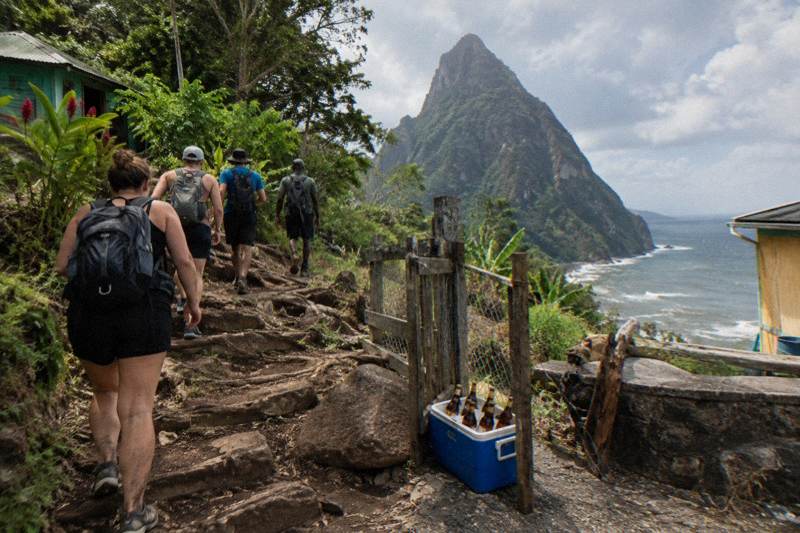
What Should You Wear To Hike Gros Piton?
Practical clothing, footwear and packing advice for the Gros Piton climb, with tour options that cover water, pickup and fees.
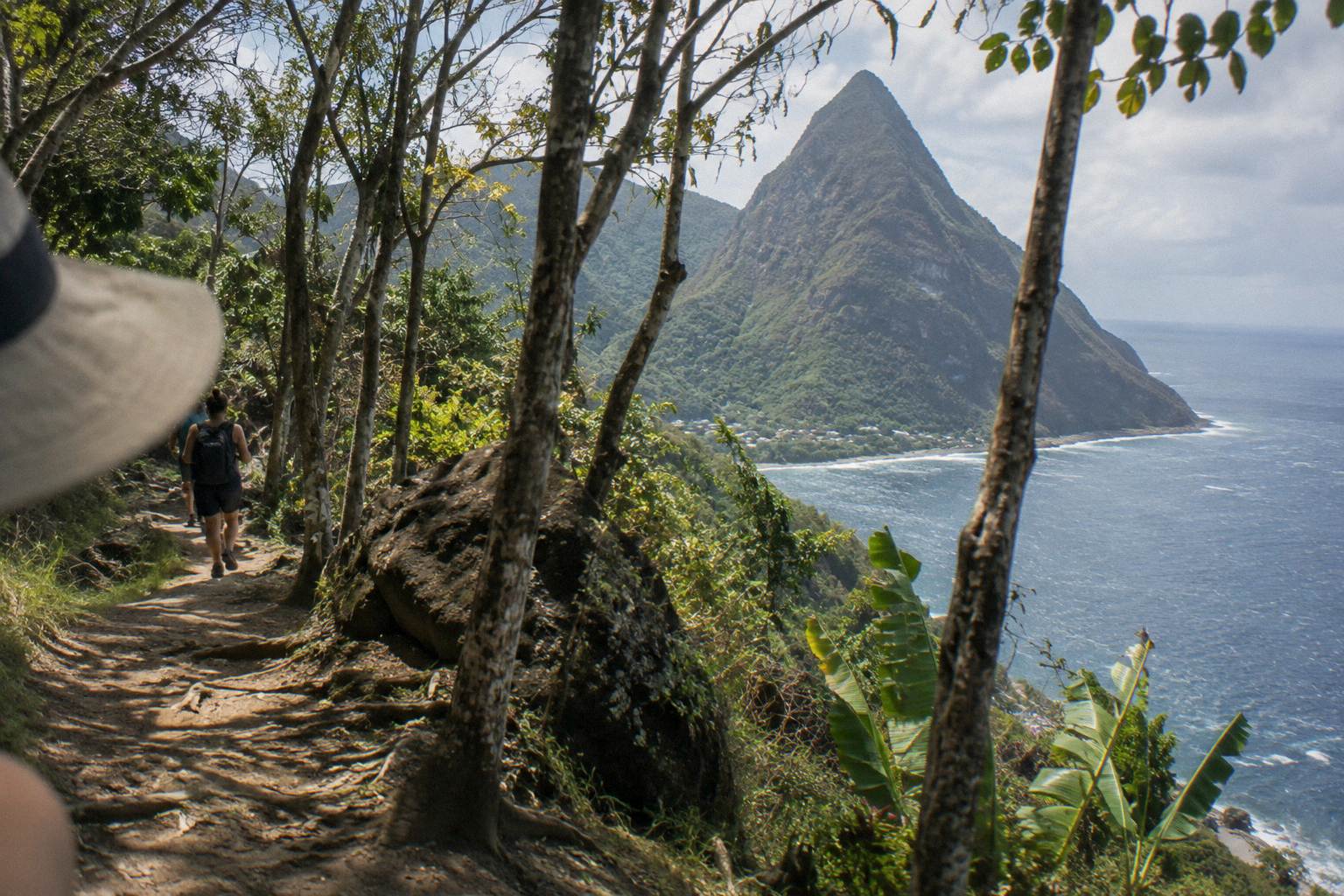
Gros Piton stands 798 m (2,619 ft) above the Caribbean near Soufriere, and the climb to its summit is a 4 km round trip that typically takes 4 to 6 hours at a moderate to challenging effort level. The trail starts at the Fond Gens Libres interpretive centre inside the Pitons Management Area, a UNESCO World Heritage site inscribed in 2004, and it moves from shaded rainforest to open, sun-battered rock before the final scramble to the top. A certified local guide is required, and the trail fee of USD 50 per adult, about XCD 125, covers entry and that guide, paid at the trailhead.
Clothing is not a small question here. The mountain serves hikers two climates in one morning, and the wrong shoes or the wrong fabric turns a rewarding day into a painful one. This page lays out exactly what to wear and what to carry, based on the trail's real conditions and on what the available tours actually include.
In short: wear broken-in trail shoes or running shoes with real grip, lightweight synthetic or merino clothing that dries fast, and a hat plus sunscreen for the exposed upper section. Carry more water than feels reasonable, at least 2 litres per person, the tourism authority's own minimum, because the climb takes 4 to 6 hours and parts of the route have no shade. Skip cotton, skip denim, and skip brand-new footwear. If you book a guided trip such as the Dannyboy Guided Hike, 5 Hours by St. Lucia Best Experience Tours & Airport Transfers, water for the hike is listed as included, but you still choose your own shoes and clothes.
For a fuller treatment of the trail's difficulty and demands, the companion page on Gros Piton Hike planning covers the climb end to end, and the related question of whether the Gros Piton climb is difficult sits close to this one: what you wear is partly a function of how hard the day will be.
Quick Facts Table
The essentials in one glance: Gros Piton rises 798 m (2,619 ft), the round trip is 4 km, and a typical day on the trail runs 4 to 6 hours at moderate to challenging effort. A certified local guide is required, and the trail fee is USD 50 per adult, covering entry and the guide, paid at the trailhead at Fond Gens Libres.
| Item | Detail |
|---|---|
| Summit height | 798 m (2,619 ft) |
| Round-trip distance | 4 km |
| Typical duration | 4 to 6 hours |
| Effort level | Moderate to challenging |
| Guide requirement | Certified local guide required |
| Trail fee | USD 50 per adult (covers entry and guide), paid at Fond Gens Libres |
| Trailhead | Fond Gens Libres interpretive centre, near Soufriere |
What Should You Wear To Hike Gros Piton?
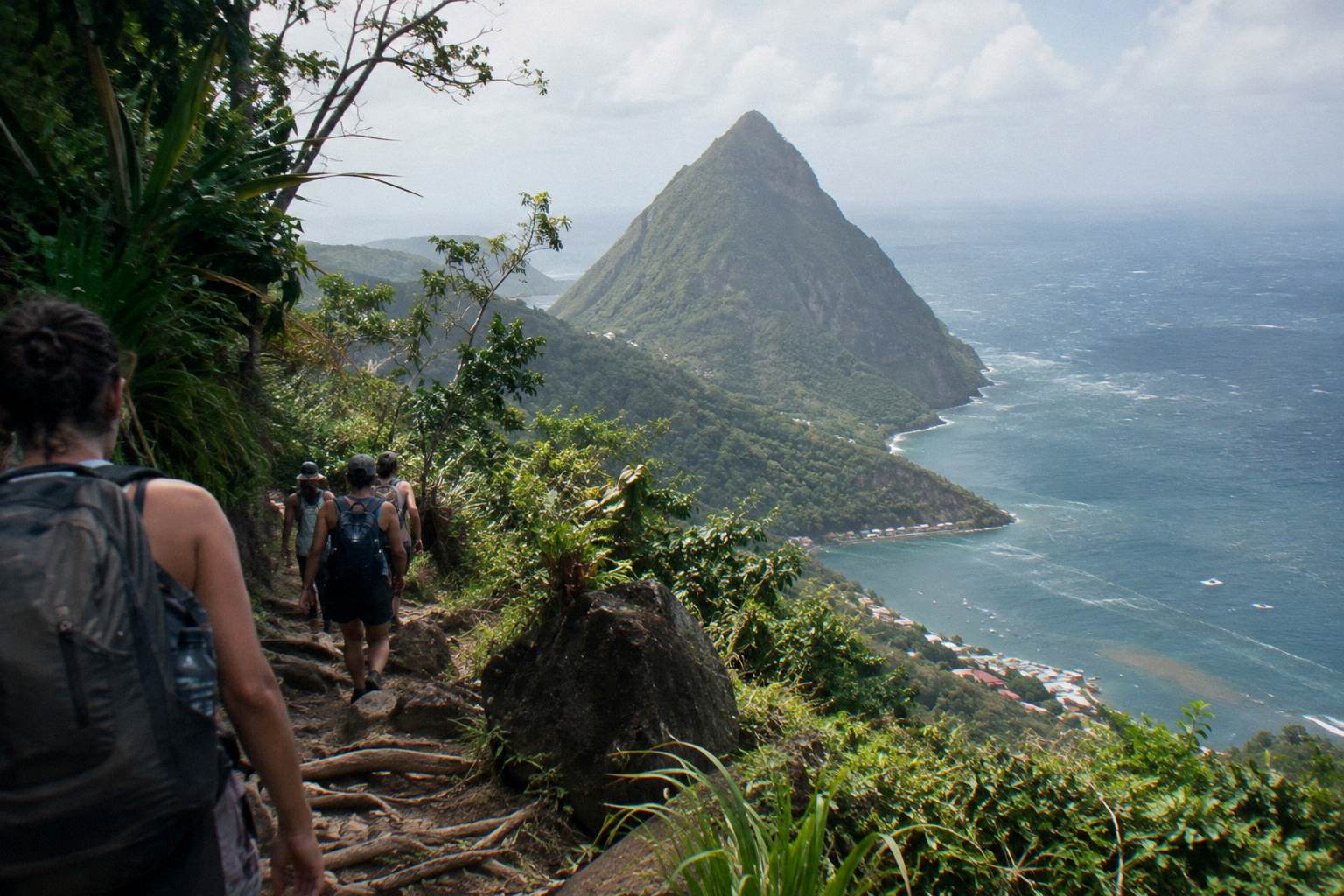
Wear grippy, broken-in shoes with real tread, lightweight synthetic or merino layers you can shed as you heat up, a brimmed hat, and sunscreen applied before the forest section ends. The route moves from shaded, sometimes damp rainforest to exposed volcanic rock, so your clothing must handle sweat on the climb and sun near the summit, and cotton, especially denim, belongs at home because it stays wet against your skin for hours.
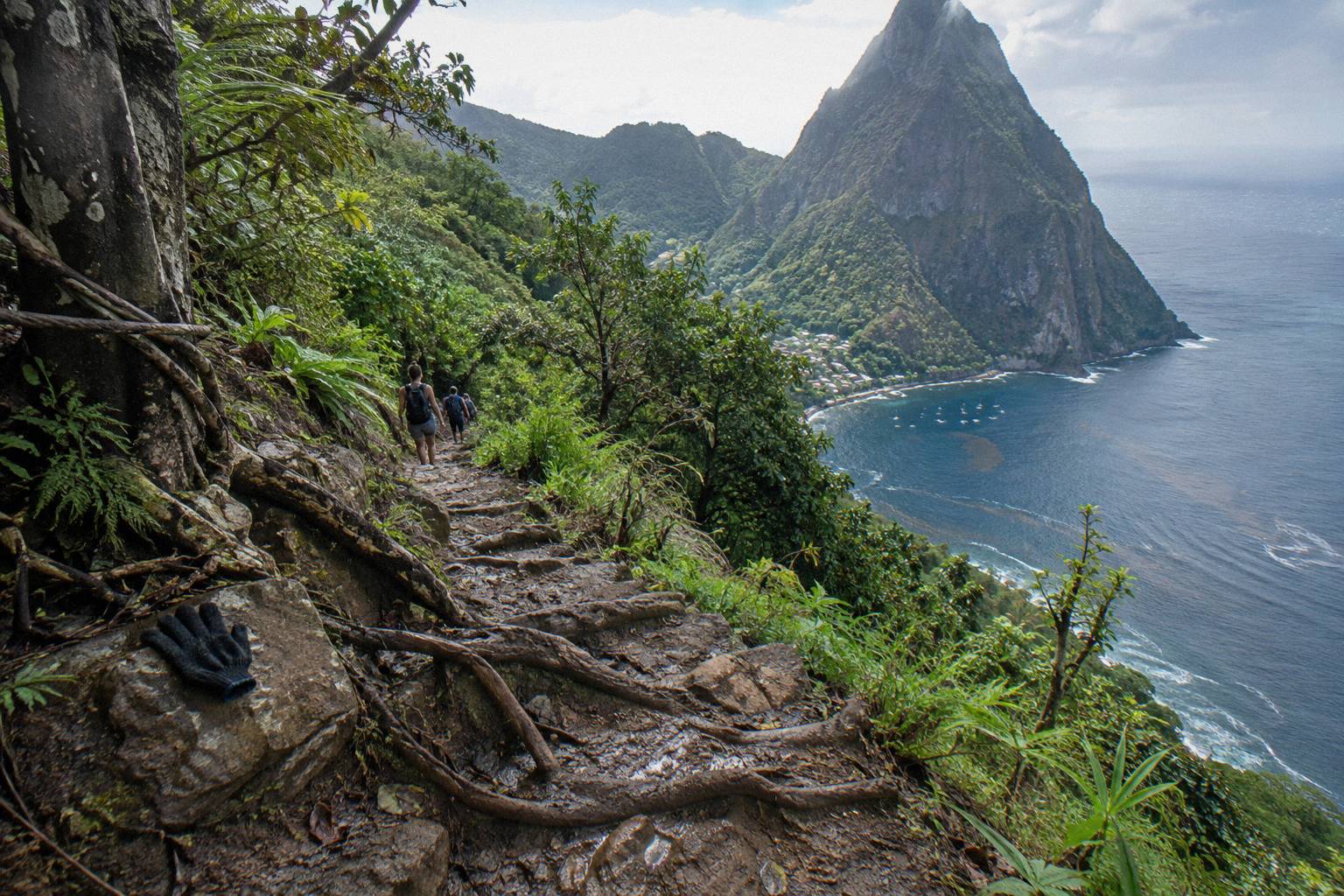
The lower half of the trail is the forgiving half. It runs through rainforest where the canopy holds moisture, the footing is dirt and root, and the temperature feels several degrees cooler than the coast. This is where hikers in cotton shirts get soaked through early and never dry out. A lightweight synthetic t-shirt or a merino base layer moves that sweat outward instead of holding it, and by the time you reach the exposed mid-section of the climb, the difference is obvious.
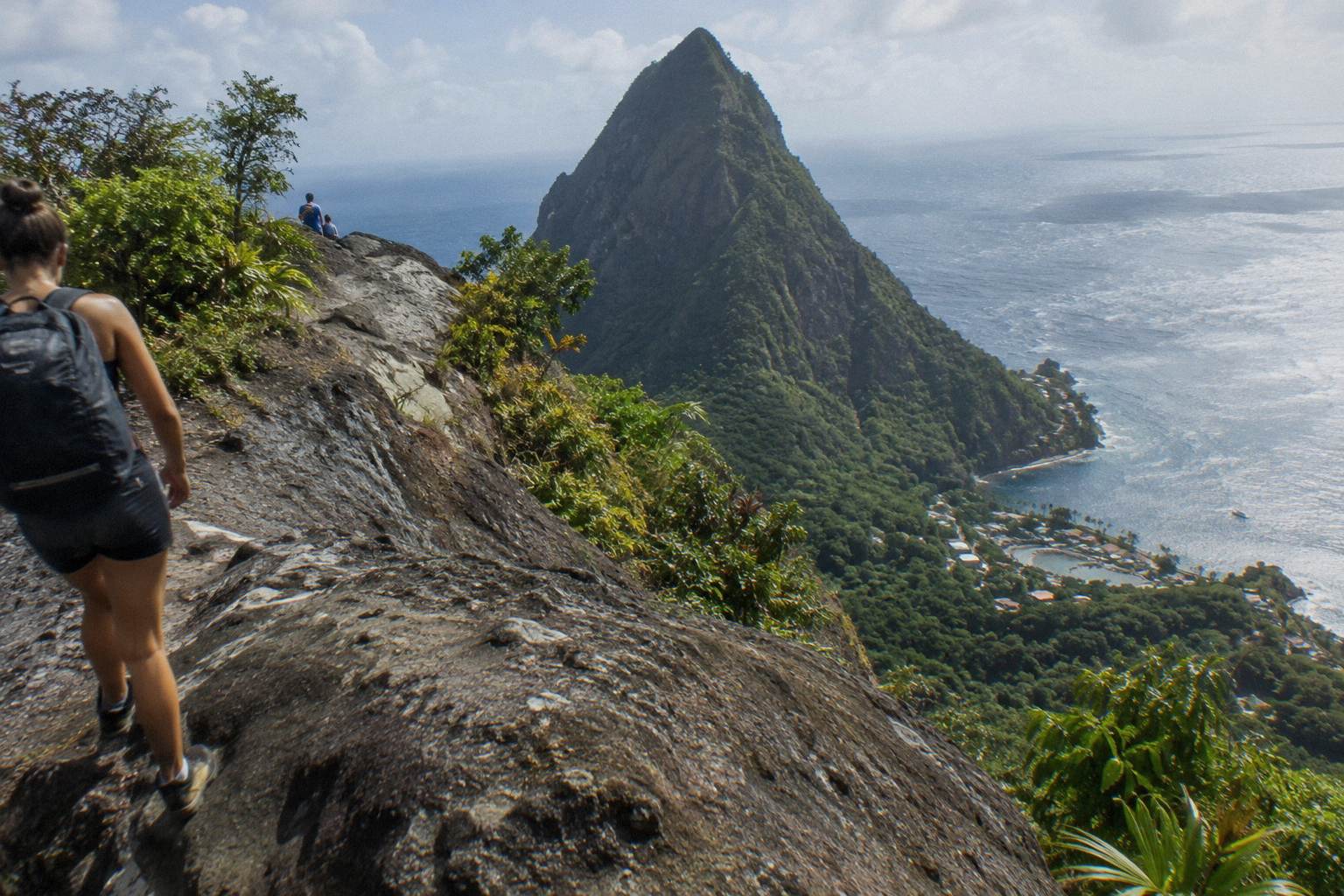
The upper half changes the problem. Tree cover thins, the rock takes over, and the sun does the work the shade was doing against you. This is where a hat earns its place in your bag, and where sunscreen applied at the trailhead, before the forest section, stops being optional. The route is a 4 km round trip but it is steep for most of that distance, so you will be moving slowly enough on the upper stretches that heat builds rather than dissipates.
Guided options shape this decision too, because what the tour carries changes what you must carry. The Dannyboy Guided Hike, 5 Hours by St. Lucia Best Experience Tours & Airport Transfers lists water for the hike and a cold Piton beer afterwards among its inclusions, runs from US$90 per person, and is rated 4.7 across 230 reviews, which makes it the most reviewed climb on this site. The Cool Vibes Taxi and Tours Private Hike, 4 To 5 Hours lists a 1.5 litre bottle per person and a local Piton beer, from US$140. Neither changes your footwear choice; both change how much water sits in your own pack.
Why Clothing Choice Matters More On Gros Piton Than On A Beach Walk
This trail combines sustained steep climbing, humidity, and a surface that shifts from packed dirt to wet rock within a single hour, so clothing and footwear failures show up faster here than on flat coastal paths. The 4 to 6 hour duration means a blister that would be a nuisance on a one-hour walk becomes a genuine problem by hour three. No outfit can promise comfort in every state of the sky.
The Saint Lucia Tourism Authority describes the Gros Piton climb as moderate to challenging and requires a certified local guide on the trail, per its official Piton climbs page. That framing matters for clothing: a "moderate" Caribbean rainforest walk might tolerate sandals and a swimsuit cover-up, while a guided 4 km ascent with rock sections does not.
The bigger context is the UNESCO Pitons Management Area, inscribed in 2004 under natural criteria (vii) and (viii), detailed at UNESCO's World Heritage listing. The site protects a distinct transitional forest zone, which is why the lower trail feels like rainforest and the summit feels like bare stone. Your clothing has to work across both.
Practically, three failure modes repeat among under-dressed hikers: shoes with no tread sliding on damp rock, cotton shirts staying soaked in the humid forest section, and unprepared skin burning on the exposed upper third. All three are cheap to avoid and expensive, in comfort terms, to suffer through.
Do you want a trip where the logistics are already handled before you lace up?
Footwear: The Single Most Important Decision
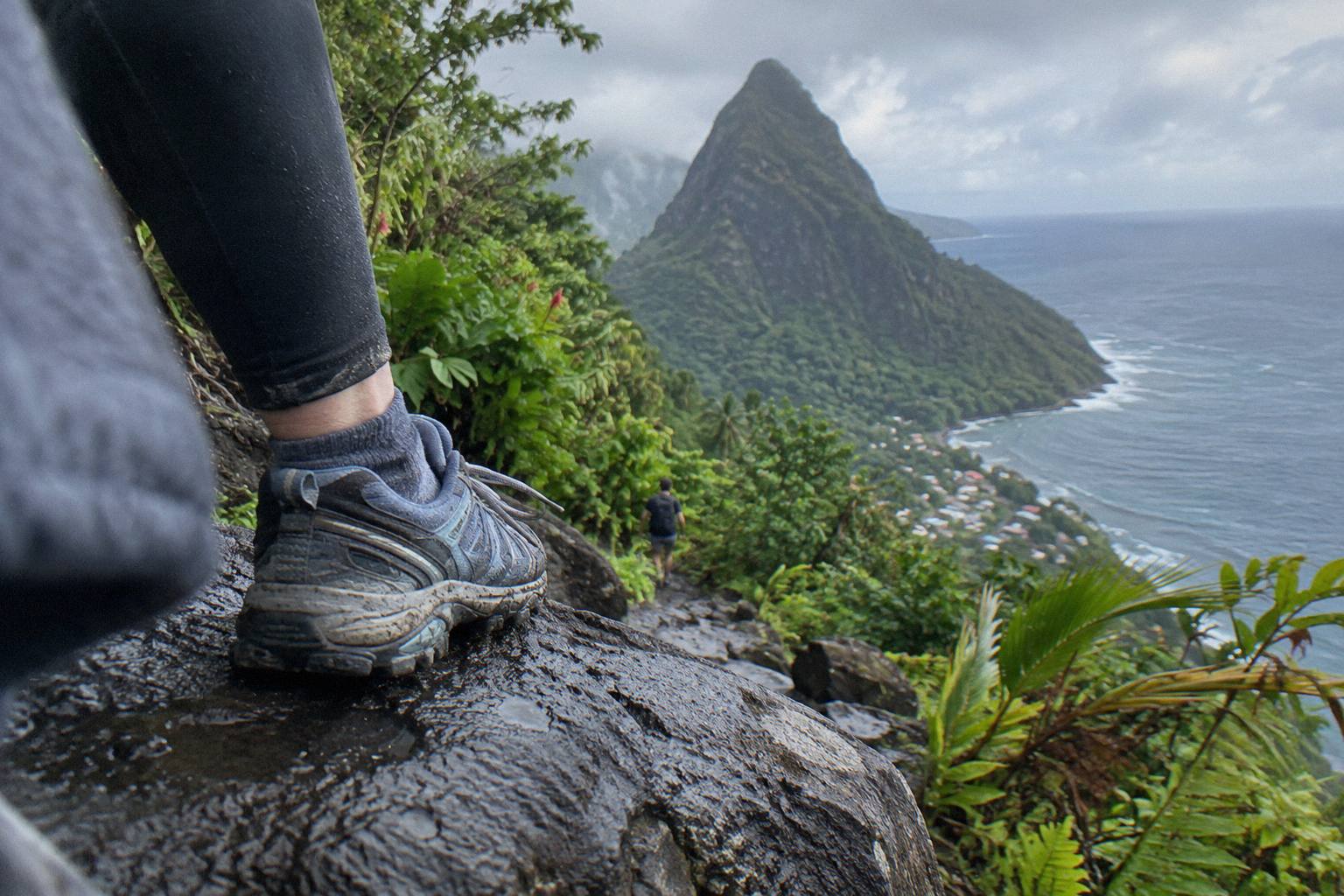
Wear broken-in trail shoes with aggressive tread, or at minimum a well-worn pair of running shoes with good grip. Do not wear new shoes, flip-flops, canvas sneakers, or anything with a smooth sole. The trail's rock sections, some of them stepped and some of them wet, punish poor traction, and the descent puts more load on your toes and knees than the ascent does. Lacing shoes snugly at the ankle reduces toe-bang on the way down.
Trail runners are the sweet spot for most people. They dry fast when the forest section wets them out, they grip the volcanic rock better than road shoes, and they are light enough not to add fatigue over 4 to 6 hours. Stiff hiking boots work too, and some hikers prefer the ankle support on the steeper pitches, but in tropical humidity they run hot, and a boot that is not fully broken in will blister you long before the summit.
Socks deserve a sentence of their own, because they are the cheapest blister insurance available. A thin synthetic or merino hiking sock, worn dry and changed if it soaks through, prevents most of the friction problems that new socks or cotton socks cause. Packing one spare pair costs almost nothing in weight and can rescue the second half of the descent.
If you are coming from a cruise port day or a hotel without gear shops, note that one operator, Treasure tours Ltd. St. Lucia, lists walking sticks and backpacks available for rent on its All Inclusive Hike, 4 Hours, from US$150 per person. Renting a stick is a live option; renting shoes generally is not, so the footwear decision stays yours.
Clothing: Fabrics And Layering That Work In Two Climates
A lightweight synthetic or merino t-shirt, quick-dry shorts or trail trousers, and one light layer for the summit rest stop cover nearly every condition the trail produces. Long sleeves help against sun and brush on the upper section but should be loose and airy, not cotton. Pack a light rain shell if the forecast looks unsettled, since rain in the mountains arrives fast and the trail becomes slick quickly when it does.
The layering logic on Gros Piton is inverted from temperate hiking. You start warm and get warmer climbing through the forest, then reach exposed rock where sun is the issue rather than cold, but the summit rest stop, standing still in trade winds after an hour of sweating, can chill you fast. One light layer that fits in a hand or ties around the waist solves that moment without weighing you down.
| Clothing Item | Best Choice | Avoid |
|---|---|---|
| Shirt | Synthetic or merino, light colour, loose fit | Cotton t-shirts, heavy fabrics |
| Bottoms | Quick-dry shorts or trail trousers | Denim, anything heavy |
| Underlayers | Synthetic or merino | Cotton, which stays wet for hours |
| Summit layer | Light fleece or windbreaker, packable | Thick jackets |
| Rain gear | Light shell in the pack from wet-season months | Umbrellas, which snag on branches |
| Hat | Brimmed, light-coloured | Dark caps that hold heat |
Colour matters more than most packing lists admit. A light-coloured shirt reflects the sun on the exposed section, while a dark one absorbs it and reads as several degrees warmer. Loose fit matters for the same reason: air movement across sweat is the cooling mechanism you have, and a tight shirt defeats it.
Swimwear is a reasonable wear-or-pack item for after the hike, since several operators combine the climb with water stops. Xceptional Tours' Private Nature Trail, 7 Hours includes entrance to Toraille Waterfall for a post-climb rinse, from US$190 per person, and St. Lucia Taxi Service's Sulphur Springs Mud Bath Hike pairs the mountain with a hot-spring soak, from US$127. Neither changes what you wear on the trail, but both give the spare set of dry clothes a purpose.
Sun, Rain And The Accessories That Earn Their Weight
Sunscreen, a brimmed hat, and sunglasses are the three accessories that matter on the upper half of the climb, where shade disappears and reflected glare off rock and sea adds to the direct sun. Insect repellent earns its place on the forest section, particularly after rain. A small towel and a spare dry shirt in the pack turn the summit stop and the drive back into civilised experiences rather than damp ones.
Apply sunscreen at the trailhead, before the forest section, even if the morning feels overcast. The exposure arrives gradually, and by the time it is obvious you are cooking, the application moment has passed. Reef-safe formulations are the courteous choice on an island where the water below the trail is part of the protected marine environment.
Rain changes the calculation more than sun does. Wet rock on the upper section is genuinely slick, and the fixed-rope character of nearby Petit Piton, a 3.2 km round trip scramble that takes 3 to 5 hours and demands a professional guide, gives a sense of how seriously the authorities treat these slopes when conditions turn. Gros Piton's trail is a walk by comparison, but wet footwear still needs careful foot placement.
On gloves: a thin pair helps on the rockier pitches for hikers with soft hands, but most climbers manage without them. If the tour you book includes a driver waiting during the hike, as St. Lucia Best Experience Tours & Airport Transfers lists for the Dannyboy Guided Hike, you can leave a dry shirt and towel in the vehicle rather than carrying them, which is the lightest packing strategy of all.
What To Carry Beyond What You Wear
Carry at least 2 litres of water per person, salty snacks, sunscreen for reapplication, a spare dry shirt, and a small bag for rubbish. Booked tours vary widely in what they include: some list water and drinks, some list entrance fees, and some list almost nothing, so the packing list depends on which trip you choose. Check each trip's booking page for exactly what it includes.
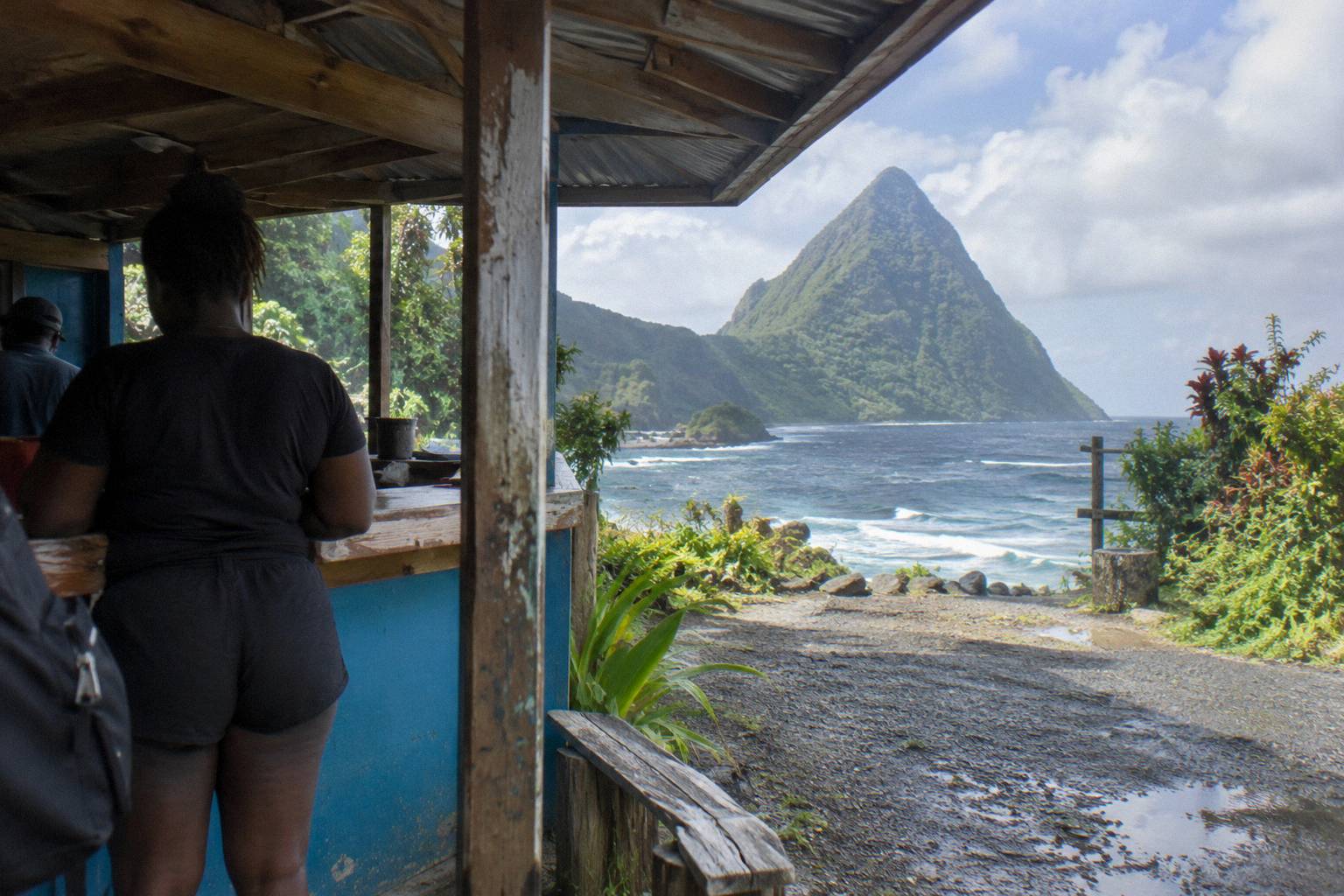
Water is the item people get wrong most often. Four to six hours of steep climbing in tropical heat is a sweat rate that drains a small bottle early, and the trail has no shop. Operators that list bottled water include A1 Transfer & Tours SLU on its Private Hike, 6 To 7 Hours, from US$130, and Tour For The Day's 6h 45m private trip, from US$112, which lists bottled water, soda and local beer. Guided group options include the St Lu Taxi and Tours Hotel Or Cruise Pickup Hike, from US$130, which lists no inclusions beyond pickup, so its climbers carry everything themselves.
| Tour | Operator | Format | Booked Length | From (US$, Per Person) | Water Or Drinks Listed |
|---|---|---|---|---|---|
| Dannyboy Guided Hike, 5 Hours | St. Lucia Best Experience Tours & Airport Transfers | Guided group | 5 hours | 90 | Water for the hike, Piton beer after |
| Private Hike, 4 To 5 Hours | Cool Vibes Taxi and Tours | Private | 4 to 5 hours | 140 | 1.5 litre per person, Piton beer |
| Private Hike, 6 To 7 Hours | A1 Transfer & Tours SLU | Private | 6 to 7 hours | 130 | Bottled water |
| Tour For The Day, 6h 45m | Tour For The Day | Private | 6h 45m | 112 | Bottled water, soda, local beer |
| Hotel Or Cruise Pickup Hike | St Lu Taxi and Tours | Guided group | 4 to 6 hours | 130 | Not listed |
The trail fee is its own line: USD 50 per adult, paid at Fond Gens Libres, covering entry and the certified guide. Some operators fold entrance fees into their price, as Xceptional Tours does, while others list the guide fee as a separate per-person charge inside the package, as A1 Transfer & Tours SLU's row does. Never assume inclusion; check the booking page for the specific trip.
A phone, a small amount of cash, and a dry bag or zip-seal bag complete the kit. The summit views, conditions allowing, are the photographic payoff of the whole day, and a soaked phone ends that plan early. For deeper planning on the kit question, the guide to what to wear and bring for the Gros Piton climb covers the same ground with a checklist format.
Mistakes That Trip Up Well-Prepared Hikers
The repeat offenders are new or unsuitable shoes, cotton everything, no hat or sunscreen for the exposed upper third, and carrying too little water for a 4 to 6 hour effort. A quieter mistake is dressing for the hotel climate rather than the mountain microclimate, which is several degrees cooler in the forest and considerably harsher in the sun. None of these are exotic errors, which is exactly why they keep happening.
New shoes top the list. A box-fresh pair of trail shoes has stiff soles and unbroken upper material, and a steep 4 km round trip with a long descent is the worst possible first outing. Wear whatever you bring on several long walks at home first.
The second mistake is treating the climb as a beach activity because it sits in the tropics. Swimwear and sandals belong to the hours after the hike, not to the trail itself, and hikers who start in them tend to finish the day with sunburn, sore feet, or both. The mountain's two climates in one climb is the core reason this page exists.
The third is water arithmetic. People budget for a one-hour walk and then find themselves on hour four, in shadeless heat, rationing the last few sips. Booked tour durations run 4 to 10 hours door to door, but the hiking authority band for Gros Piton is 4 to 6 hours on the trail, and hydration has to cover the trail time, not the brochure time.
Finally, do not overpack out of anxiety. A heavy pack makes the climb harder in exactly the way light clothing prevents. One litre and a half to two litres of water, snacks, sun kit, a spare shirt and a rain shell in wet months is a complete load for most climbers.
Booking A Trip That Lightens Your Pack
Guided group tours and private trips differ mainly in transport, inclusions and price, with options spanning US$90 to US$300 per person depending on format and length; the Dannyboy Guided Hike, 5 Hours from US$90, is the most reviewed choice at 4.7 across 230 reviews, while private climbs cost more for door-to-door service. Pick the trip whose listed inclusions cover what you would rather not carry.
FRAM Tours & Taxi Services' FRAM Soufriere Hike, 6 Hours lists round-trip transport with hotel, port, Airbnb and villa pickup and a driver who waits for the duration of the hike, from US$200 per person. Travelers Env's private 4-hour hike from US$120 lists bottled water and little else, which suits climbers who bring their own kit. Lush Excursions' World Heritage Hike, 8 Hours from US$195 lists water, entrance fee and lunch, the fullest food package among the shorter climbs.
Whatever you book, the clothing and footwear advice above does not change. Shoes with grip, fast-drying fabric, sun protection, and enough water: that combination, plus a certified guide and the USD 50 trail fee at Fond Gens Libres, is the whole formula for a good day on the mountain.
Common Questions About What To Wear
What Should You Wear To Hike Gros Piton?
Wear broken-in trail shoes or running shoes with real grip, a lightweight synthetic or merino shirt, quick-dry shorts or trousers, a brimmed hat and sunscreen. Carry a spare dry shirt and a light layer for the summit stop. Avoid cotton and denim entirely, since both stay wet for hours in the humid forest section.
Do I Need Hiking Boots For The Gros Piton Climb?
The tourism authority's packing list recommends hiking boots with strong grip; well broken-in trail runners with real tread are a lighter alternative.
Should I Wear Long Sleeves Or Shorts?
Either works if the fabric is lightweight and quick-drying. Loose long sleeves protect against sun and brush on the exposed upper section, while shorts keep you cooler in the forest. Many climbers wear shorts and add sunscreen rather than sleeves.
What Kind Of Shoes Should I Avoid?
Avoid flip-flops, sandals without a heel strap, canvas sneakers with smooth soles, and any shoe that is brand new. The trail's rock sections are slick when damp, and the long descent punishes poor footwear and soft soles.
Do The Tours Provide Water And Gear?
Some do, and it varies by operator. The Dannyboy Guided Hike, 5 Hours lists water for the hike and a beer afterwards; Cool Vibes Taxi and Tours lists 1.5 litres per person; Treasure tours Ltd. St. Lucia lists walking sticks and backpacks for rent. Check the specific trip's booking page before assuming anything is included.
Does What I Wear Change If It Rains?
Rain mainly changes footing rather than clothing. Wet rock demands careful foot placement and grippy soles, and a light rain shell in your pack keeps the forest section from soaking you. Umbrellas snag on branches and are not worth carrying.