Is The Gros Piton Climb Safe?
A research-based answer to how safe the Gros Piton climb really is: the verified trail facts, the guide requirement, the fee, and which booked tours fit a cautious hiker.
Yes, the Gros Piton climb is safe for a reasonably fit hiker who takes basic precautions: start early, carry water, and hike with a certified local guide. The guide requirement comes from the tourism authority itself, which mandates guides rather than merely recommending them, so booking one is part of planning the climb, not an optional add-on. The Saint Lucia Tourism Authority describes Gros Piton as moderate to challenging: 798 m (2,619 ft) of summit, 4 km round trip, typically 4 to 6 hours on foot. No official source publishes an age limit, a fitness threshold or a weather closure rule, so those judgements stay with you and your guide, not with a website.
That is the honest headline, and it comes with an equally honest caveat. Safety on this mountain is mostly a function of three decisions made before you lace up: who guides you, when you start, and what you carry. The trail itself is well trodden and stays inside the Pitons Management Area, the UNESCO World Heritage site inscribed in 2004 under criteria (vii) and (viii) for its natural significance. You can read the formal case on the UNESCO listing for the Pitons Management Area, and the climb basics on the Saint Lucia Tourism Authority's Piton climbs page.
What follows unpacks each of those decisions. The short version is that guided climbers routinely come down tired, sore and thrilled. The avoidable problems are the familiar ones: heat and dehydration, afternoon storms, inadequate shoes, and treating a mountain like a photo stop. If you want a deeper look at the route itself, the companion guide on the Gros Piton trail route and its stages breaks the climb into sections; this page stays on the safety question.
If you are already past the worrying stage and just want a well-supported climb, the three options below cover the common cases: a shared guided trip, a guided climb with flexible pickup, and a longer guided day.
What Makes The Gros Piton Trail Moderate To Challenging?
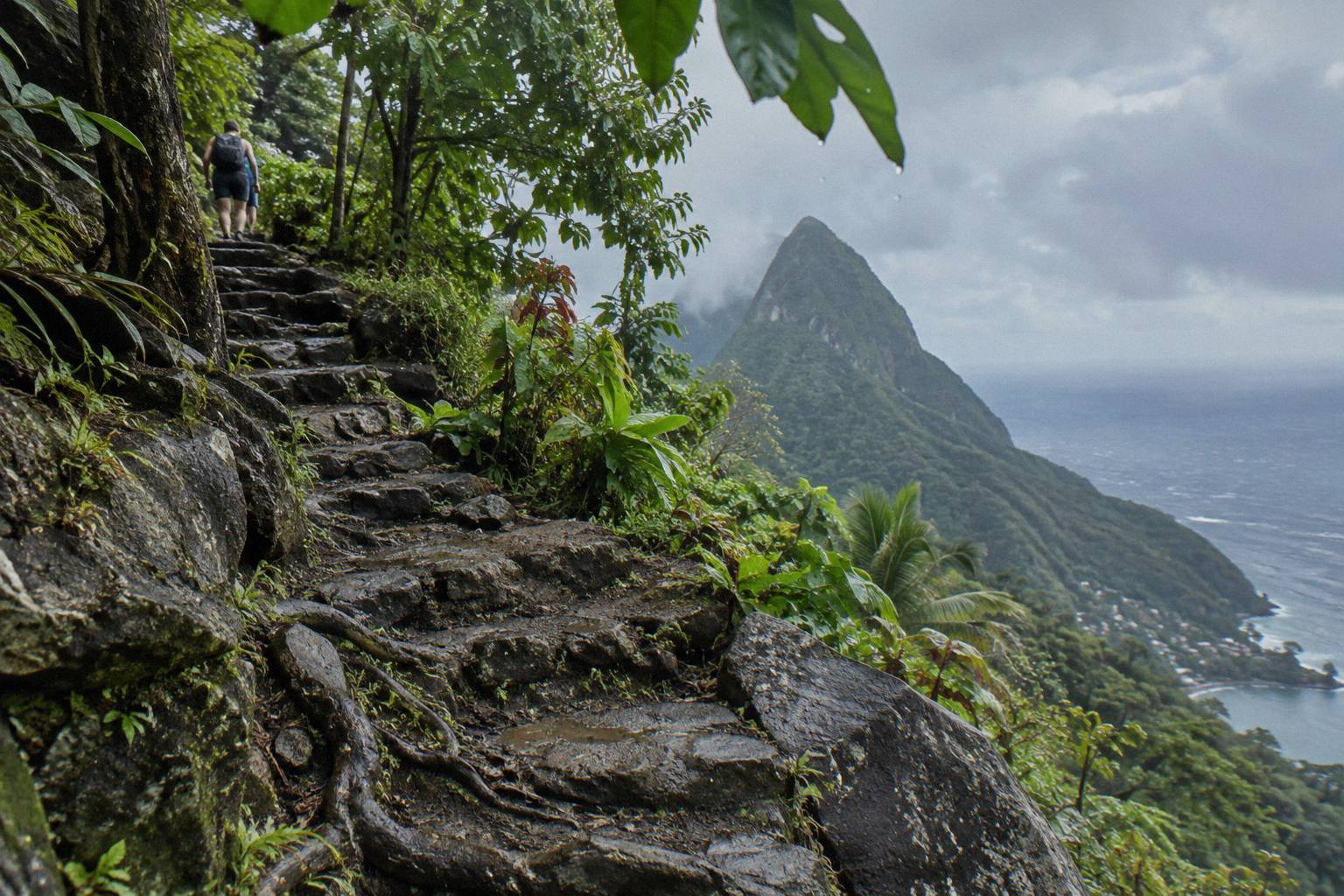
The Gros Piton Trail earns its moderate to challenging rating through three combined factors: the steepness of the grade, the intensity of the heat, and the duration of the climb, rather than any technical difficulty. What tests hikers is not climbing skill but the stamina needed to keep ascending a long, steep, hot trail. The official figures are 798 m (2,619 ft) of height and 4 km round trip, typically 4 to 6 hours of walking, which the tourism authority grades as moderate to challenging. There is no roped scrambling on Gros Piton, unlike its neighbour; the difficulty is sustained steepness over rainforest terrain that turns slick after rain, combined with tropical humidity that makes a modest hill feel like twice the work.
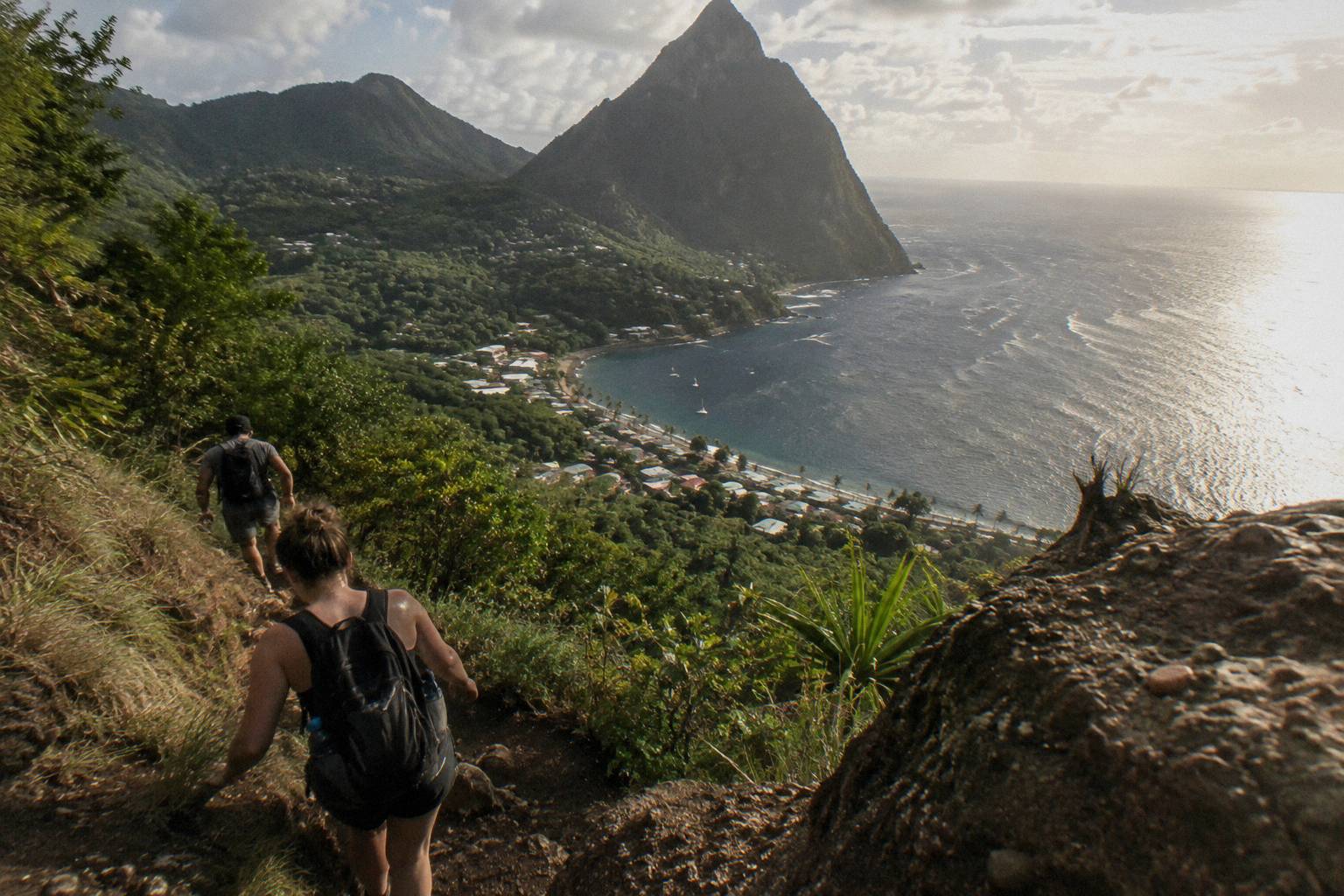
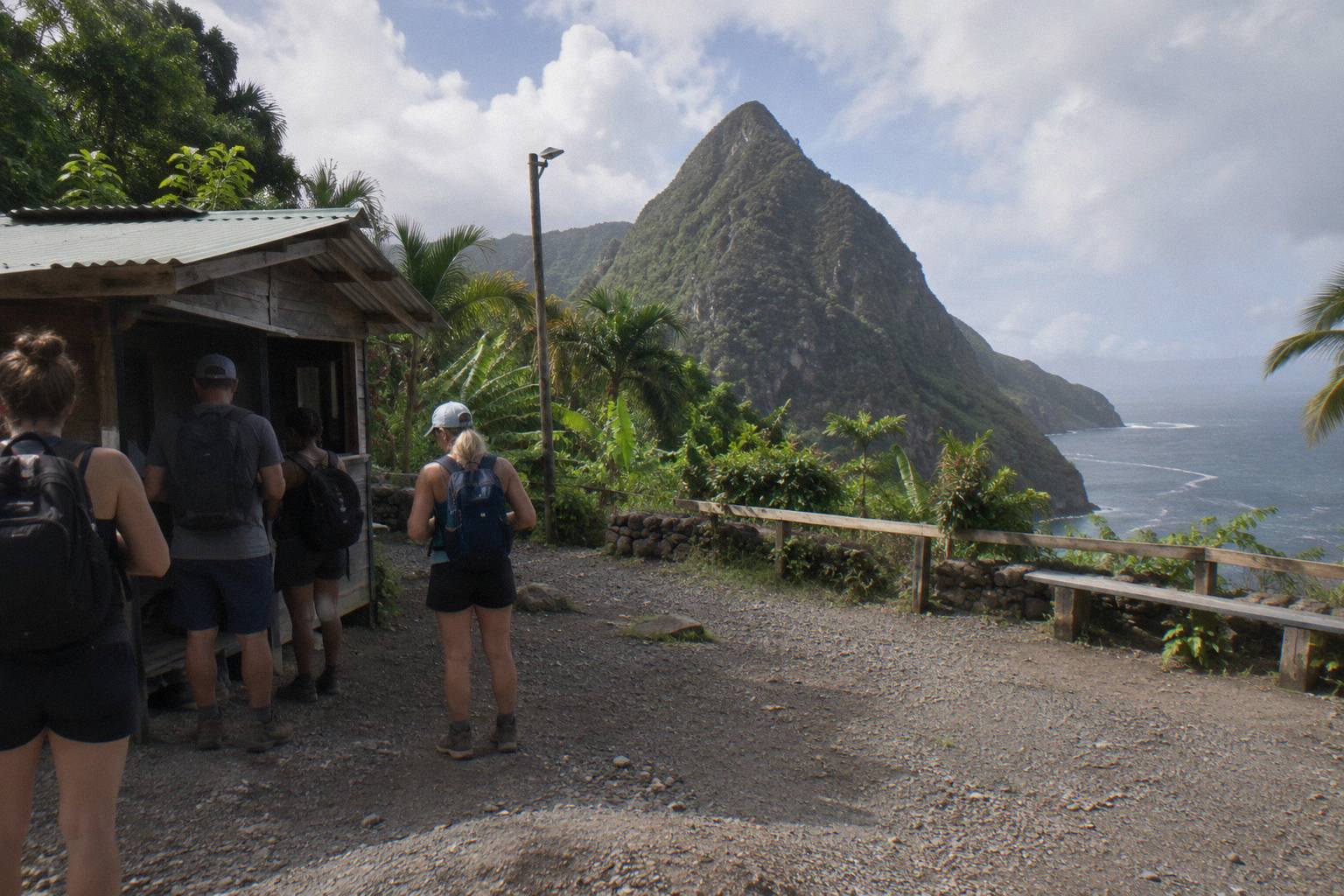
The trail starts at the Fond Gens Libres interpretive centre near Soufriere and climbs through the Pitons Management Area on a path that alternates between dirt steps, rock slab and root ladders. Lower down it is shaded forest, which helps with heat but not with footing. Higher up the tree cover thins, the sun arrives, and the last stretch to the summit involves short scrambles over bare rock that are manageable dry and genuinely unpleasant wet. No official source publishes an elevation gain figure, so treat any number you see elsewhere with suspicion.
Three factors do most of the work in moving a hiker from the "moderate" end of the scale to the "challenging" end:
- Starting time. An early start buys cooler forest hours and finishes the exposed upper section before the midday sun peaks.
- Footwear. Grippy trail shoes or light boots with real tread; smooth-soled sneakers on wet rock are the single most common cause of slips.
- Pace and water. Four to six hours is the typical band, and hikers who try to halve it pay for it on the descent, when tired legs meet downhill load.
For a sense of how the difficulty compares across the island's famous walks, the guide on how difficult the Gros Piton climb really is grades it against alternatives, and the comparison of the Gros Piton and Petit Piton routes side by side shows why the two are not interchangeable.
Is A Guide Required, And Does A Guide Actually Make It Safer?
Yes, hiking Gros Piton requires a certified local guide under the rules of the area's tourism authority, and the requirement is far more than paperwork. In practical terms, the guide is the safety system on this mountain, which means hiring one answers both the question of legality and the question of protection at the same time. The fee structure backs that up: the USD 50 per adult visitor trail fee, about XCD 125, paid at Fond Gens Libres, covers both entry and the certified guide in one payment. There is no sanctioned version of this climb where you walk up alone, and the reasons are concrete rather than bureaucratic.
A local guide knows the sections that flood, the rock slabs that stay greasy after rain,. Guides also carry the pacing discipline that visitors routinely lack, and they can read the cloud build-up that precedes an afternoon storm. In a group format, a second layer of support exists in the driver and vehicle waiting at the bottom, which is exactly how the larger guided days are structured. For what the guide actually does hour by hour, see the companion page on what your Gros Piton guide does.
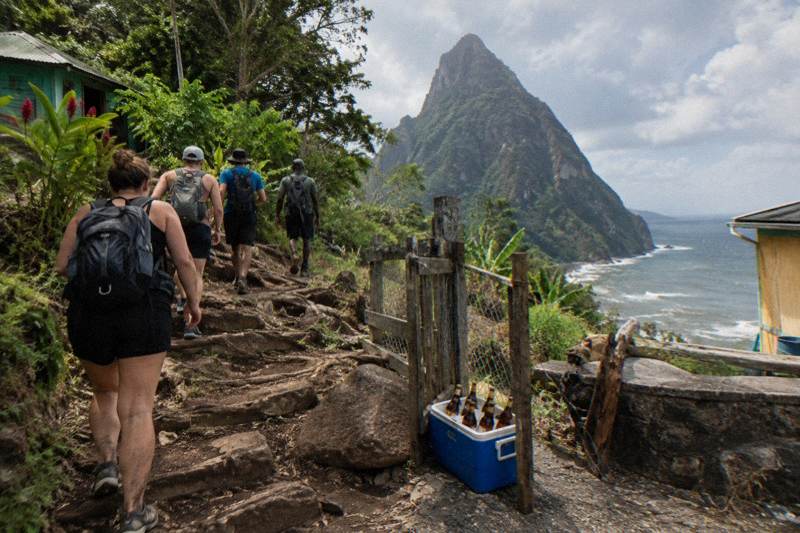
The booked trips make this easy to see. Dannyboy Guided Hike, 5 Hours by St. Lucia Best Experience Tours & Airport Transfers, the most reviewed climb available at 4.7 across 230 reviews from US$90 per person, includes water for the hike and a cold Piton beer after, hotel pickup and drop-off, help coordinating the forestry guide, and a driver who waits during your climb. Hotel Or Cruise Pickup Hike by St Lu Taxi and Tours, from US$130 per person, covers hotel and cruise-port pickup for the same guided group format on a 4 to 6 hour booking. Longer still, World Heritage Hike, 8 Hours by Lush Excursions, from US$195 per person, bundles the entrance fee, lunch and water into a full guided day.
For a middle option in a private format, this is one of the cleanest choices:
A private trip is not inherently safer than a guided group; the guide requirement applies either way. What private buys you is pace control, which matters if your fitness is a question mark or your party spans a range of abilities.
What Are The Real Risks On The Gros Piton Climb?
The real risks are heat and dehydration first, slips on wet rock second, afternoon weather third, and cardiac strain fourth. None of them are exotic, and all of them are manageable with sensible preparation: enough water, proper footwear, an early start, and an honest assessment of your fitness before you commit to the climb. No official source publishes accident statistics, weather closure rules or rescue figures for the trail, so any confident number you read about injuries on Gros Piton should be treated as invented. What can be said firmly is what the terrain and climate make likely.
Heat is the quiet one. Humid rainforest climbing at Caribbean latitude drains fluids faster than a cool-weather hiker expects, and dehydration shows up as dizziness and poor judgement precisely when the trail is steepest. Carry more water than feels reasonable; the listed trips that list water typically include 1.5 litres per person or bottled water as a baseline, which is a fair planning reference. Everything else covered here is indexed on Gros Piton Hike.
Slips cluster on the descent and on wet rock. The upper section's bare stone is fine dry and treacherous after rain, and the root-and-step forest sections hold moisture long after a shower passes. This is a footwear and concentration problem, not a route-finding one.
Weather is a timing problem. Mornings are typically the stable window; clouds and showers build through the afternoon in the wet season. Start early, and be willing to accept a guide's call to turn around. Summit views are never a promise; they depend on the conditions. The mountain is the same mountain on a cloudy day.
Finally, honesty about your own cardiovascular health matters more here than any piece of gear. Four to six hours of sustained climbing at grade is a genuine aerobic workload, and the guide to fitness and preparation for the climb sets out a sensible ramp-up plan.
What Trips People Up: Common Mistakes
Most problems on Gros Piton trace back to the same four repeatable mistakes, and none of them are the mountain's fault. Hikers run into trouble not because the trail defeats them, but because of errors they make themselves, which means every one of those mistakes can be avoided with a little preparation and honest self-assessment. They show up in the same order every season, from cruise passengers to resort guests to confident trekkers who underestimated the heat.
- Starting too late. A mid-morning start puts the exposed upper third under midday sun, and the tired hours at the top of the fatigue curve.
- Wrong shoes. Fashion sneakers, worn tread, or brand-new boots worn for the first time on a 798 m climb.
- Too little water. One small bottle for a 4 to 6 hour round trip is the classic error; plan from the 1.5 litres-per-person baseline that tour inclusions use.
- Ignoring the guide's pacing. Surging ahead on the lower forest section, then bonking at the slabs.
The fix for all four is boringly simple, and it is the same advice locals give: start early, dress for heat with real traction, carry more water than you think you need, and treat your guide's turnaround calls as final. The packing detail is worth a separate read in the guide on what to wear and bring for the climb.
Which Booked Tours Fit A Cautious Or First-Time Climber?
For a cautious or first-time climber, a guided group trip is the best fit, since it bundles pickup, water, and a waiting driver, the exact format most first-timers settle on. For a specific pick, this site's most reviewed option is also its cheapest priced climb, so that popular choice costs the least. That combination, rare in tourism, is worth spelling out: Dannyboy Guided Hike, 5 Hours from US$90 per person carries 230 reviews at 4.7, includes hotel and cruise-port pickup, water on the trail and a driver who waits, and offers free cancellation inside a 24 hour window.
The private alternatives trade cost for control. Private Hike, 5 To 6 Hours by IslandTime SLU, from US$150 per person, runs a private vehicle with water, sodas and all fees and taxes included on a 5 to 6 hour booking. Private Hike, 6 To 7 Hours by A1 Transfer & Tours SLU, from US$130 per person, lists the US$50 per person hike and guide fee among its inclusions.
| Trip | Operator | Format | Booked duration | Price | Reviews |
|---|---|---|---|---|---|
| Dannyboy Guided Hike, 5 Hours | St. Lucia Best Experience Tours & Airport Transfers | Guided group | 5 hours | From US$90 | 4.7 across 230 |
| Hotel Or Cruise Pickup Hike | St Lu Taxi and Tours | Guided group | 4 to 6 hours | From US$130 | No rating read |
| Private Hike, 5 To 6 Hours | IslandTime SLU | Private | 5 to 6 hours | From US$150 | 5.0 across 4 |
| Private Hike, 6 To 7 Hours | A1 Transfer & Tours SLU | Private | 6 to 7 hours | From US$130 | 4.7 across 18 |
| Barefoot Holidays Hike, 8 Hours | Barefoot Holidays | Guided group | 8 hours | From US$175 | 3.8 across 9 |
| Both Pitons, 10 Hours | Lush Excursions | Both-Pitons day | 10 hours | From US$300 | No rating read |
Booked duration is the whole tour length including transfers, not hiking time; the authority band for time on foot is 4 to 6 hours. The safety relevance of that distinction is real: an 8 or 10 hour booking means a long day in the sun around the climb, which suits trained hikers rather than nervous ones.
For readers weighing the private route on price, this operator keeps the entry point low:
How Does Gros Piton Compare With Petit Piton For Safety?
Gros Piton is the forgiving sibling of the two, and the safety gap between them is wide. While Gros Piton offers a steadier, more manageable climb, Petit Piton is the more demanding ascent of the pair, so hikers concerned with safety will find Gros Piton the clear choice. The tourism authority grades Gros Piton moderate to challenging with a certified guide required, while Petit Piton is a 743 m (2,438 ft) climb over just 3.2 km round trip, 3 to 5 hours, very challenging and technical, with a professional guide mandatory and fixed ropes on the scramble sections. One is a steep hike; the other is a mountaineering outing in everything but name.
Petit Piton remains a permitted climb, listed openly by the tourism authority, so any claim that it is closed or banned is simply wrong. But the safety margin is different in kind. The shorter distance concentrates the grade, the ropes exist because the rock requires them, and the guide standard steps up from certified local guide to professional. A climber who found Gros Piton at the top of their range should not treat Petit as a next-week upgrade.
For the full breakdown, the guide to the Petit Piton climb covers its ropes, grades and guide standard in detail.
Can You Do The Climb Safely From A Cruise Port Day?
Yes, and cruise-port pickup exists on several listed trips, so the trail itself is not what should worry you. The real risk on a port day is the clock, because your time budget is set by the ship's schedule, and that constraint, rather than anything on the climb, is what you need to plan around. A 4 to 6 hour booking that includes port pickup and a waiting driver is built for exactly this case, and operators including St. Lucia Best Experience Tours & Airport Transfers and St Lu Taxi and Tours flag cruise-port pickup on their guided rows. The safety question becomes a logistics question: whether the booked day leaves a margin for the climb's 4 to 6 hours on foot plus transfers, without a rushed descent.
The disciplined answer is to pick a trip whose booked duration and pickup promise match your ship's window, confirm the timing on the booking page before you commit, and lean on the free cancellation most rows carry inside a 24 hour window if the itinerary shifts. Operators cannot promise a ship-safe return; only your own schedule check can. The dedicated guide on climbing Gros Piton from the cruise port works through the timing math.
What A Safe Climb Looks Like, Hour By Hour
A safe climb is unglamorous from its first hour to its last: an early alarm, a full water bottle, real shoes on your feet, a guide you actually listen to, and, at whatever hour the mountain asks for it, the willingness to turn around before the summit rather than after something goes wrong. Nothing in the verified record suggests Gros Piton is unusually dangerous; everything in it says the mountain demands ordinary mountain respect. The 798 m summit, 4 km round trip and 4 to 6 hour band reward steady pacing over bravado, and the guide requirement means the single biggest safety decision, who walks with you, has already been made for you.
Before you go, the practical checklist is short. Confirm what your booked trip includes, since inclusions differ row by row: some list entrance fees in the price, others list the US$50 per person hike and guide fee as an inclusion, and water, pickup and a waiting driver appear on most but not all. Check the weather window with your guide rather than an app. Read the booking page's cancellation terms, which on the rows here typically allow free cancellation inside a 24 hour window. Then climb within yourself.
If you are choosing between the main guided options, these three cover the range most visitors need, from the cheapest priced and most reviewed climb to a full-day World Heritage itinerary.
More on the wider picture, including how the island's other walks stack up, sits in the guide to the best hikes in St Lucia with the Pitons first.
Common Questions About The Gros Piton Climb
Is The Gros Piton Hike Safe?
For a reasonably fit hiker with a certified guide, early start, proper shoes and enough water, yes. The tourism authority grades it moderate to challenging: 798 m, 4 km round trip, typically 4 to 6 hours. The main risks are heat, wet rock and fatigue, all of which preparation covers. No official source publishes accident statistics, age limits or closure rules.
Do I Need A Guide To Climb Gros Piton?
Yes. The tourism authority requires a certified local guide, and the USD 50 per adult trail fee paid at Fond Gens Libres covers entry and the guide together. Walking up unguided is not a sanctioned option.
Is Gros Piton Harder Than Petit Piton?
No, Petit Piton is the harder climb. Gros Piton is a steep 4 km round trip hike graded moderate to challenging; Petit Piton is a 3.2 km round trip scramble with fixed ropes, graded very challenging and technical, with a professional guide mandatory. Both are permitted climbs.
What Is The Biggest Safety Risk On The Climb?
Heat and dehydration, followed by slips on wet rock, particularly on the descent and the bare upper slabs. Carry water on the scale of the 1.5 litres per person that tour inclusions use as a baseline, wear grippy footwear, and start early.
Can Beginners Climb Gros Piton?
Regularly, and safely, when they choose a guided format, climb within their pace and treat the 4 to 6 hour band honestly. A private trip lets a nervous or mixed-ability party control the pace. Anyone with a cardiovascular condition should treat this as a genuine aerobic workload and seek medical advice first.
What Happens If The Weather Turns During The Climb?
No official weather closure rule is published, so the call sits with your guide on the day. Guides routinely turn parties around when clouds or storms build, and a summit view is never a promise. Turning around is the safe and normal outcome, not a failure.