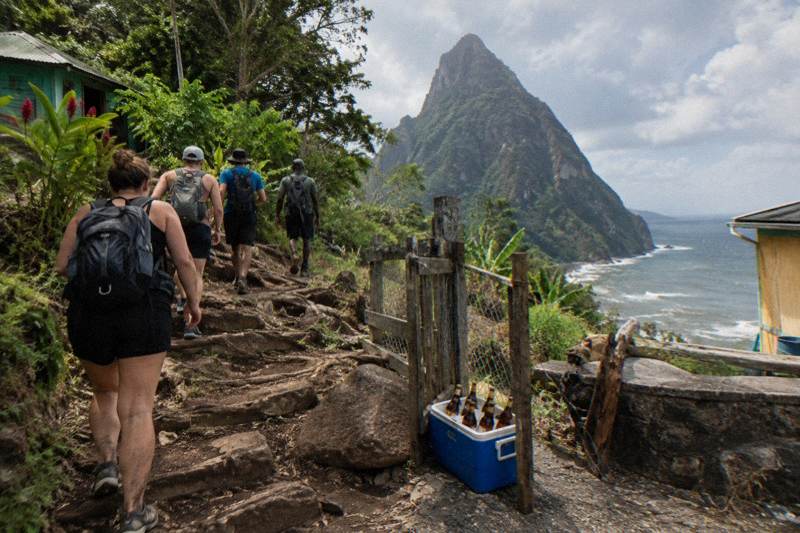
Gros Piton Summit Views And Photo Spots On The Climb
The photographs that sell people on Gros Piton are usually taken from a boat or a beach, not from the summit. Here is what the top of the 798 m mountain actually shows you, where the strongest photo spots sit on the way up, and how to plan a climb that leaves time to use a camera.
Short answer
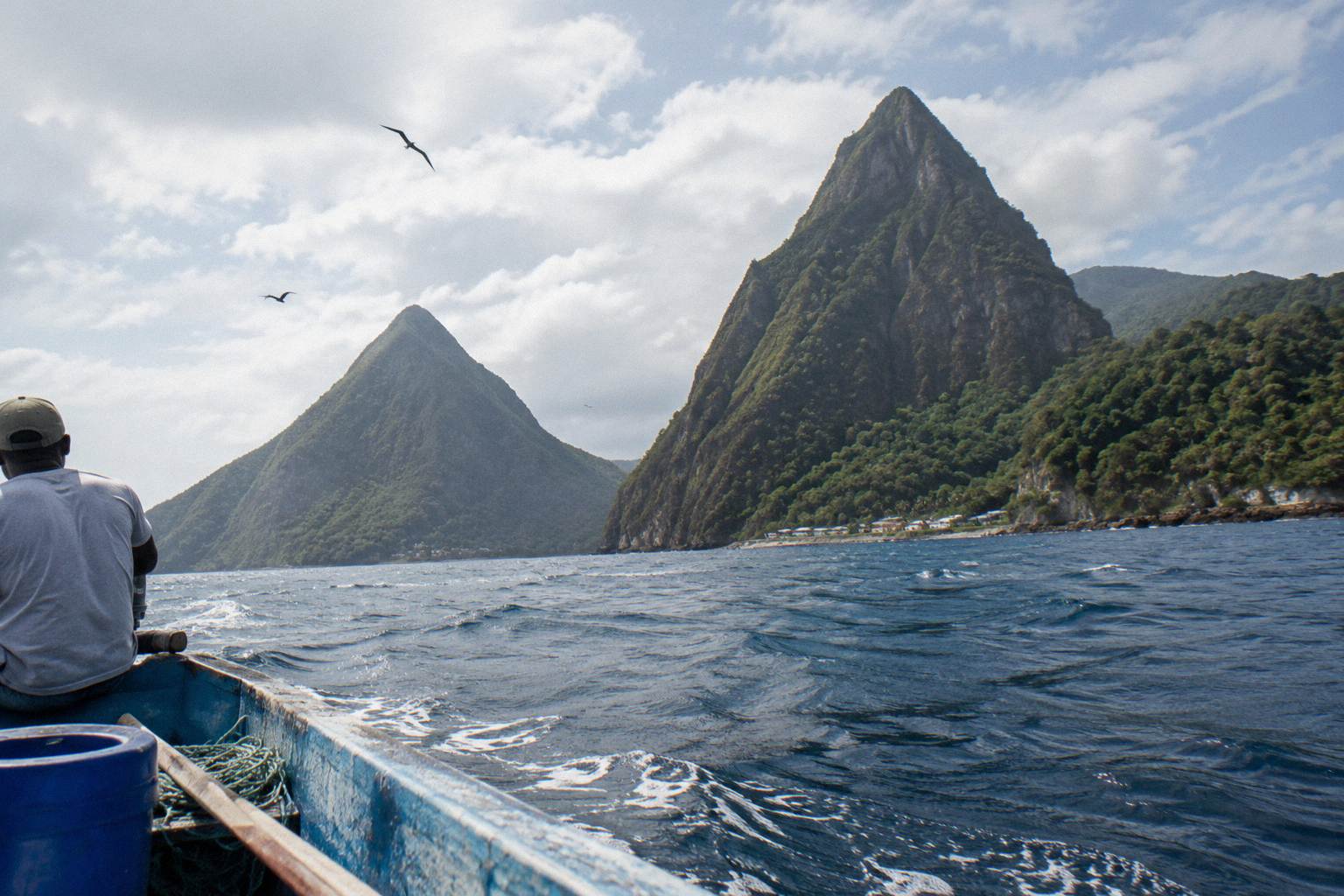
Gros Piton stands 798 m (2,619 ft) above the coast near Soufriere, and the climb covers 4 km round trip in roughly 4 to 6 hours with a certified local guide required. From the top, conditions allowing, you look down on Petit Piton, Soufriere, and the Caribbean Sea. The trail fee is USD 50 per adult, paid at Fond Gens Libres.
Many of the best-known photographs of Gros Piton are taken from a boat, a beach or the Tet Paul ridge, not from the mountain itself, with the peak filling the frame. Climbing the peak flips that perspective entirely: you become the thing other people photograph, and the views you get are of Petit Piton, the Soufriere coastline, and open Caribbean water stretching to the horizon. This page covers what the summit actually shows, where the reliable photo spots sit on the trail, and how to pick a tour that gives you the minutes at the top that good pictures need.
The mountain is real and specific: 798 m (2,619 ft) of volcanic rock at the southern end of St Lucia, inside the UNESCO inscribed Pitons Management Area, climbed from the Fond Gens Libres interpretive centre near Soufriere. The Saint Lucia Tourism Authority's piton climbs page confirms the numbers that matter for photographers: 4 km round trip, typically 4 to 6 hours, moderate to challenging, with a certified local guide required on every ascent. The entry and guide fee is USD 50 per adult, paid at the trailhead, and it is covered in detail on the Gros Piton cost and entrance fee guide.
| Fact | Figure |
|---|---|
| Summit height | 798 m (2,619 ft) |
| Round trip distance | 4 km |
| Typical time | 4 to 6 hours |
| Difficulty | Moderate to challenging |
| Guide requirement | Certified local guide required |
| Trail fee | USD 50 per adult, covers entry and guide |
| Trailhead | Fond Gens Libres interpretive centre near Soufriere |
| UNESCO status | Pitons Management Area, inscribed 2004 |
What Can You Actually See From The Top Of Gros Piton
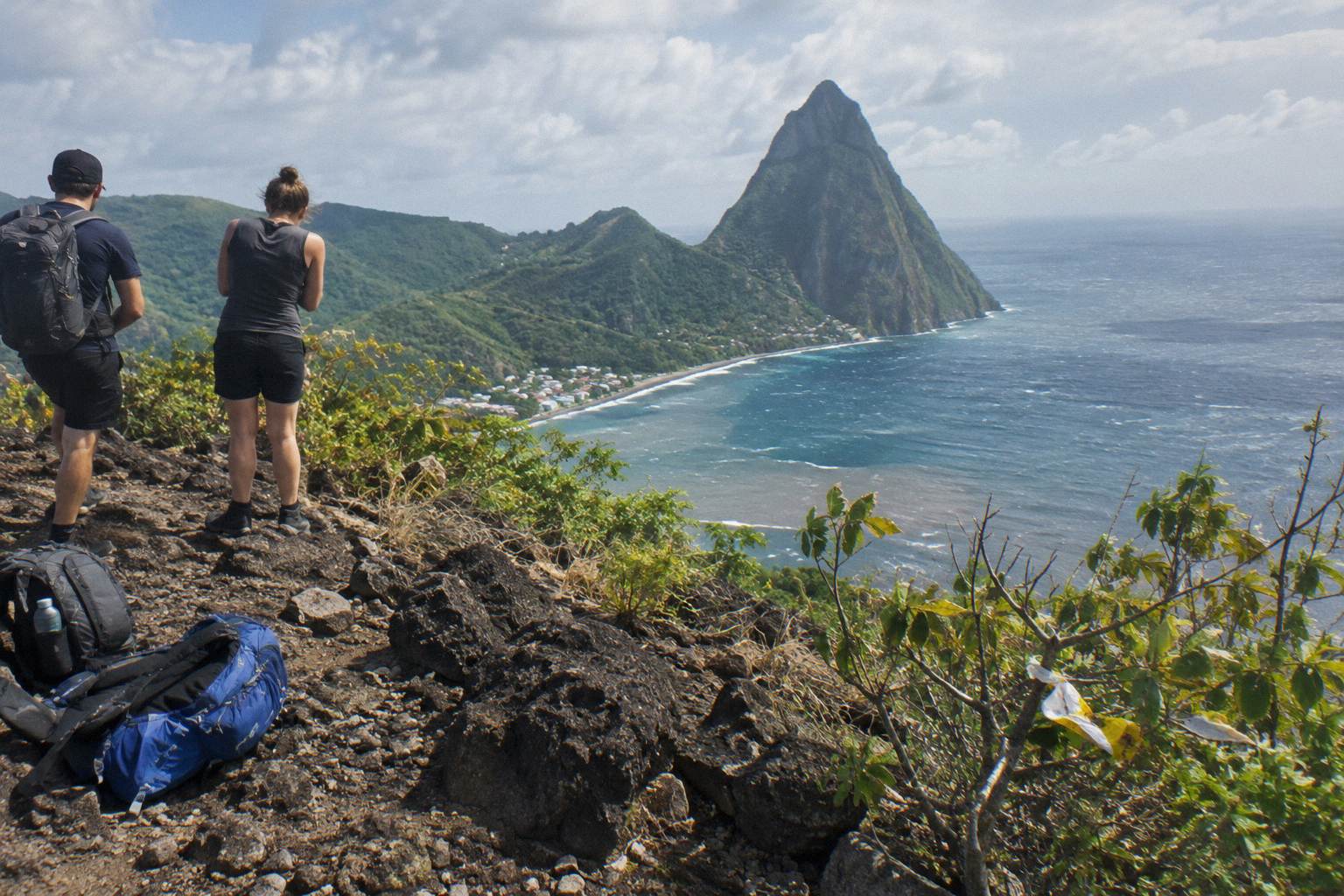
From the summit of Gros Piton, conditions allowing, the view opens across Petit Piton to the south, the town of Soufriere and its bay to the north, and the Caribbean Sea filling the western horizon. You are looking down on cloud level at times, which is the single most photographed phenomenon from the top. The summit itself is a small rocky platform rather than a wide lookout, so composition is about the panorama, not the foreground.
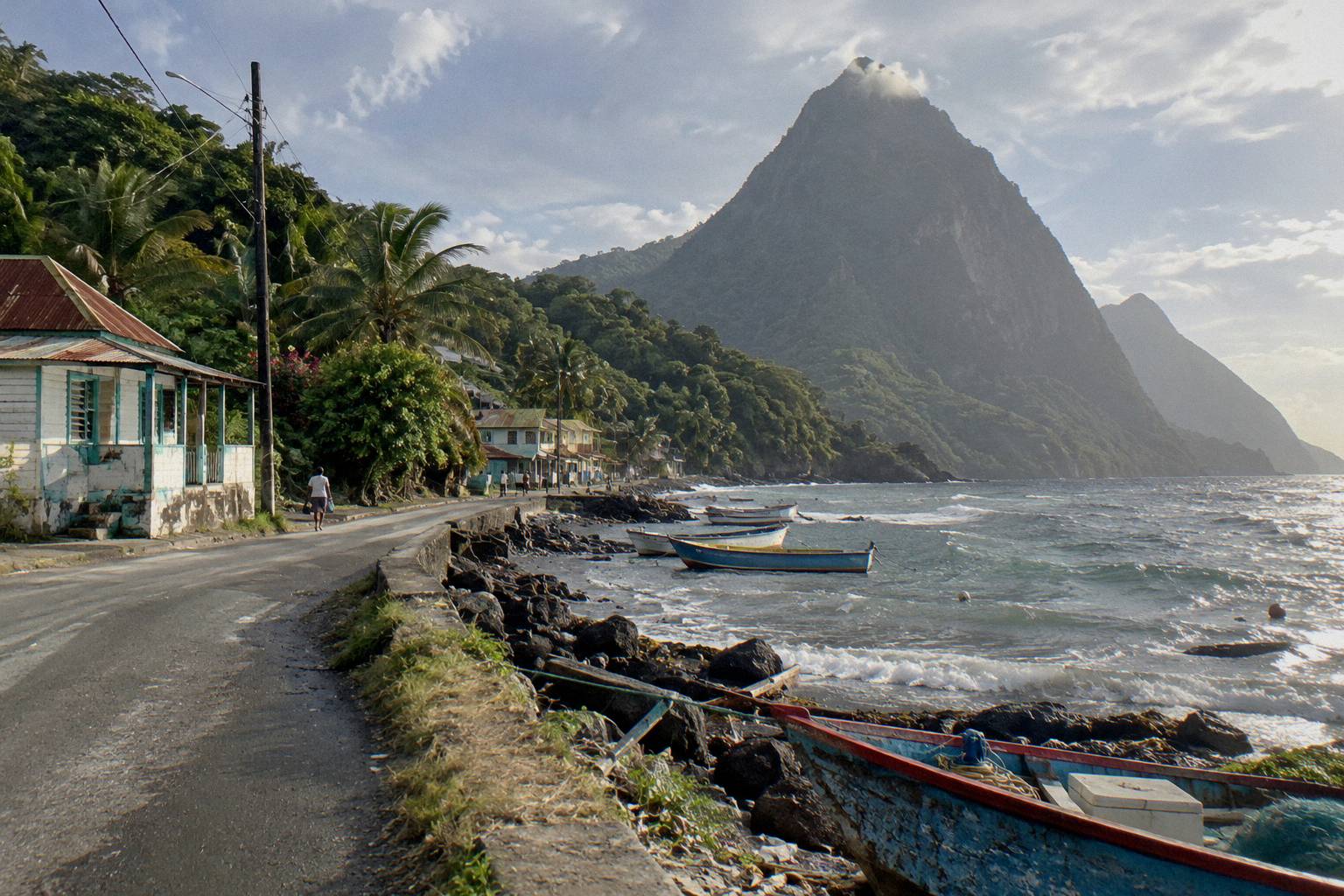
The first thing that surprises most climbers is how steeply the island drops away. Gros Piton rises almost directly from the sea, and from 798 m the coastline reads as a map: the curve of Soufriere Bay, the dark sand of the volcanic beaches, the green shoulders of the inland rainforest. To the south, Petit Piton at 743 m (2,438 ft) appears close enough to study, its rope-assisted scramble lines invisible at that distance but its full profile unmistakable. On clear days the interior ridgelines of St Lucia stack to the north, and the sea takes over everything to the west. The mountain and its geology are the reason the whole area earned UNESCO protection in 2004 under criteria recognizing both its scenic value and its volcanic significance, and the Pitons Management Area listing explains why the landscape is managed the way it is.
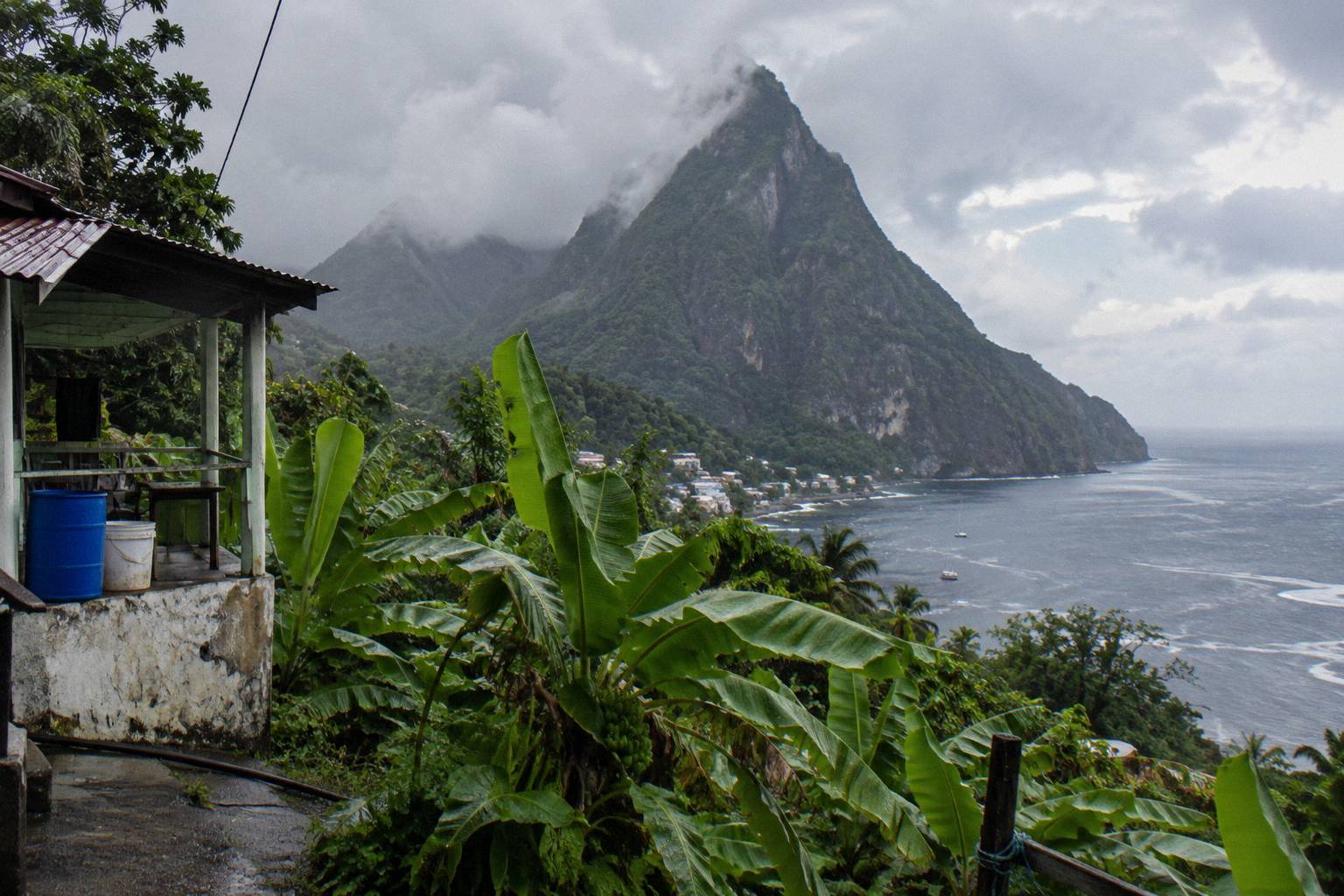
The honest caveat belongs in every planning conversation: the summit is frequently in cloud. This is a tropical mountain by the sea, and the same moisture that keeps the forest green builds against the upper slopes through the morning. Many climbing parties reach the top inside cloud, wait, and get a partial clearing. Some get nothing. None of this is predictable far in advance, and no operator can promise visibility. The practical consequence, covered in the weather section below, is that a photographer who treats the entire 4 km as the shoot, not just the final ten metres, almost always comes home with strong images regardless of what the summit does.
What you will not see matters too. You cannot see the summit of Petit Piton in detail, you cannot see the east coast of St Lucia, and you are not high enough for curvature of the earth theatrics. The reward is intimate rather than alpine: a low tropical summit with the sea on three sides and a sister peak in the frame. Framed that way, it is one of the more distinctive summits in the Caribbean.
Where The Best Photo Spots Sit On The Gros Piton Trail
The strongest photographs on Gros Piton usually come from three zones: the open clearings in the middle third of the climb, the shoulder just below the summit boulders, and the summit platform itself, in that order of reliability. The lower forest section is dark and cluttered, so treat it as a warm up. The middle clearings are where Petit Piton first appears in frame, and they hold their light longer than the summit does.
The trail from Fond Gens Libres begins in cultivated land and then enters forest, where the canopy closes and photography becomes difficult: contrast is harsh, the grade is steep, and there is little to compose. This changes in the middle third, where the path crosses open ground and the view west toward the sea opens for the first time. These clearings are the workhorse photo spots of the whole climb. Petit Piton sits off to the south, the coast drops away below, and because you are below the main cloud band more often than not, the light here tends to hold even when the summit has disappeared. Most guided groups pause at these openings to drink and regroup, which is exactly when a camera should come out.
Higher up, the vegetation drops to scrub and the ridge narrows toward the summit block. The shoulder below the final boulders is the second key spot, because it frames the climb itself: rock, sky, and the sea beyond, with enough room to step back and compose. The summit platform is third, and it is a small one, so parties take turns at the top. Your certified guide, whose role is described in the what your guide does guide, will typically manage the timing at the top, and the minutes you get there are the variable most worth protecting when you choose a tour.
A practical note on the descent: the seaward views that were behind you on the way up are now in front of you, and the afternoon light angles across the coast. Many strong images are taken going down, when the pressure of the summit is off. The full route, stage by stage, is mapped on the Gros Piton trail route and stages guide, which pairs well with the trail map page for orientation.
| Zone on the trail | What it shows | Photographic reliability |
|---|---|---|
| Lower forest section | Canopy, roots, stone steps | Low, dark and cluttered |
| Mid trail clearings | Petit Piton, coast, sea horizon | High, light holds below cloud |
| Upper scrub slopes | Ridge line, rock textures | Good in clear conditions |
| Shoulder below summit boulders | Full climb context, sea beyond | Good, room to compose |
| Summit platform | Wide panorama, cloud level | Variable, cloud dependent |
| Descent, seaward turns | Angled coastal light | High, often overlooked |
Booking a climb that gets you up in good time matters here, and the tours here offer real choices. The Dannyboy Guided Hike, 5 Hours from St. Lucia Best Experience Tours & Airport Transfers is the most reviewed climb available, rated 4.7 across 230 reviews, from US$90 per person, with hotel and cruise-port pickup, water on the trail, and a cold Piton beer afterwards. On the private side, the Private Hike, 4 To 5 Hours from Cool Vibes Taxi and Tours runs from US$140 per person with private transport and both hotel and cruise-port pickup, rated 3.9 across 102 reviews. Guided group value sits between them with the Hotel Or Cruise Pickup Hike from St Lu Taxi and Tours, from US$130 per person, covering both pickup types.
Between those two paragraphs sit the three climbs most photographers end up comparing. Reading their booking pages side by side before deciding is the fastest way to see which pickup option and price point fits your day.
What The Summit Platform Itself Is Like For Photographers
The top of Gros Piton is a compact rocky shelf, not an observation deck, and it holds a summit party for only a few minutes at a time. There are no railings, no signage, and no shelter, just bare rock with a steep world on three sides. For photography this means wide lenses and quick work, because the space for stepping back and reframing simply does not exist up there.
Climbers sometimes expect a groomed viewpoint similar to a drive up lookout, and Gros Piton is nothing of the kind. The final approach involves hands on rock, and the summit is the natural end of that terrain. Composition is therefore vertical and panoramic: shoot the horizon wide, use the rock itself sparingly as foreground, and let Petit Piton or the sea carry the frame. Portrait orientation works well for the classic pairing of summit rock and coastline. People photography is constrained by the space, so group summit shots are tight and best taken quickly while the guide holds the pause.
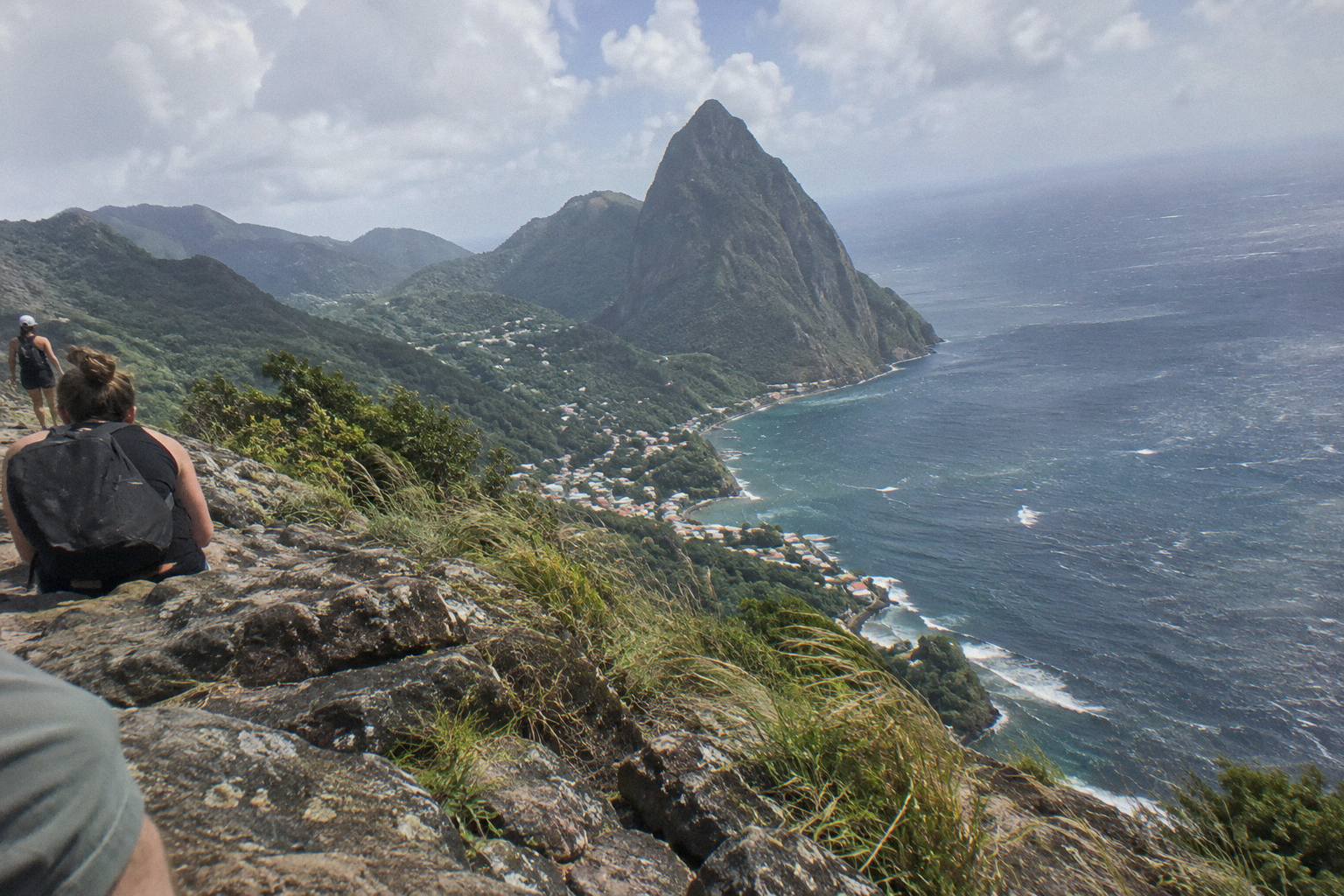
Cloud behaviour is the defining summit experience. When the cap is in, the platform sits inside grey vapour and there is nothing to shoot but rock and the people beside you. When it lifts, the reveal is fast and dramatic, and the sea appears as a sheet of silver or deep blue depending on the angle of the light. Many guides time the summit pause for a clearing if one is building, but no one controls it, and it is worth saying plainly that no tour can promise a view. What you can control is your readiness: camera out, battery spared on the climb, and settings roughly dialled in before the final scramble so the clearing does not pass while menus are being tapped.
The summit is also where the sense of scale lands. Petit Piton, which from Sugar Beach looks like an equal, reads as a distinct and slightly lower mass with its own cloud interactions, and the scramble up its 3.2 km round trip with fixed ropes, a tougher 3 to 5 hour proposition requiring a professional guide, is visible as terrain rather than a postcard silhouette. The comparison between the two peaks is covered fully on the Gros Piton versus Petit Piton guide.
Which Tours Give You Enough Time For Photos At The Top
Tour length and summit time are different things, and the booked duration printed on a tour covers the whole outing including transport, not the hours on the trail. The 4 to 6 hour authority band for the climb itself is the constant across every operator, so the meaningful differences between tours are format, price, and what the price includes, not how long you stand on the summit.
This distinction trips up a lot of buyers, and it is worth unpacking. A tour booked as 5 hours might include a drive from a hotel, the 4 to 6 hour climb, and a stop on the way back, all inside that booked window. A tour booked as 8 hours is not an 8 hour hike, it is a longer day with more around it. The how long the climb takes guide covers this in depth. For photographers the question to ask on the booking page is whether the itinerary includes anything after the descent, because a day that ends at the trailhead gives you more flexibility on the mountain than one with a fixed second stop.
| Tour | Operator | Format | Booked duration | Price per person | Reviews |
|---|---|---|---|---|---|
| Dannyboy Guided Hike, 5 Hours | St. Lucia Best Experience Tours & Airport Transfers | Guided group | 5 hours | From US$90 | 4.7 across 230 |
| Private Hike, 4 To 5 Hours | Cool Vibes Taxi and Tours | Private | 4 to 5 hours | From US$140 | 3.9 across 102 |
| Private Hike, 6 To 7 Hours | A1 Transfer & Tours SLU | Private | 6 to 7 hours | From US$130 | 4.7 across 18 |
| World Heritage Hike, 8 Hours | Lush Excursions | Guided group | 8 hours | From US$195 | 1 review |
| FRAM Soufriere Hike, 6 Hours | FRAM Tours & Taxi Services | Private | 6 hours | From US$200 | 7 reviews |
| Travelers Env Private Hike | Travelers Env | Private | 4 hours | From US$120 | 1 review |
The private format has a specific appeal for photographers: a private climb moves at your pace within the guide's safety judgement, and the driver waits. The Private Hike, 6 To 7 Hours from A1 Transfer & Tours SLU, from US$130 per person and rated 4.7 across 18 reviews, includes private transport, bottled water, and lists the hike and guide fee of USD 50 per person within its price structure, which is worth checking against the trail fee explanation before comparing totals. The FRAM Soufriere Hike, 6 Hours from FRAM Tours & Taxi Services, from US$200 per person, includes the Gros Piton trail entrance fee and hotel, port, Airbnb and villa pickup, with the driver waiting at the location for the duration of the hike regardless of time. The Travelers Env Private Hike, from US$120 per person, is a leaner 4 hour private option with bottled water.
The tile above links to the live booking page for the A1 Transfer private climb, where the current price, pickup details and cancellation terms are shown in full. Comparing two or three of these pages before committing is the sensible pattern on Gros Piton Hike and everywhere else in island travel.
On the guided group side of the same question, the World Heritage Hike, 8 Hours from Lush Excursions, from US$195 per person, includes bottled water, the entrance fee, and lunch, which makes it a full day built around the climb rather than just transport to it. For anyone weighing a mud bath add on against more mountain time, the Gros Piton and Sulphur Springs combo guide sets out how those days are structured.
How Weather And Cloud Shape What Your Photos Show
Cloud, not rain, is the main photographic variable on Gros Piton, and the mountain builds its own against the upper slopes as the day warms. Early starts generally climb in clearer air, but nothing about summit visibility is guaranteed on any day, on any tour. The correct strategy is to photograph the whole 4 km, treat the summit cap as a bonus, and never promise yourself a view in advance.
Tropical maritime mountains work like this: overnight and early morning air is often stable, and as the sun heats the slopes, moisture lifts and condenses into the cap that swallows the top section. Climbers describe watching the summit clear and refill within a single pause. Rain, when it comes, is usually brief and heavy, and the forest sections stay damp regardless, which is why footwear and clothing choices matter as much as camera choices, a topic covered on the what to wear and bring guide.
For the camera, the practical reading is simple. Expose for the bright sea when it appears, because the rock foreground is dark and recoverable in a way that a blown horizon is not. Shoot the clearing aggressively rather than waiting for a better one. Keep a lens cloth reachable, because the combination of sweat, drizzle and salt haze fogs glass constantly. And put the phone away for the steepest sections, where hands belong on rock, a point the Gros Piton safety guide makes at length.
The seasonal picture is covered on the best time to hike guide, but no season promises summit visibility, and the honest framing is that every month produces both postcard days and whiteout days. If summit photography is the entire point of your trip, build in a spare day on island rather than gambling a single morning on it.
Photography Gear And Phone Settings For The Climb
A modern phone in a secure pocket outperforms an ambitious camera bag on this climb, because the trail demands both hands at times and the summit rewards speed over gear. Whatever you carry should be strapped, zipped or slung so it cannot swing, and spare batteries belong in a dry bag, since there are no charging points on a mountain. Keep the kit small enough that it never becomes the reason you slow down.
Start with restraint. The 4 km round trip is steep enough that every gram is felt, and the photographic wins are wide panoramas and people shots, neither of which needs long glass. If you bring an interchangeable lens camera, one versatile zoom and a polarising filter do the work, with the filter cutting sea glare and deepening the tropical sky. Phones handle the scene well, and their panoramic modes suit the summit platform's constrained space. The one accessory that earns its weight is a simple cross body strap or chest harness, which keeps the camera reachable during the pauses where the light happens.
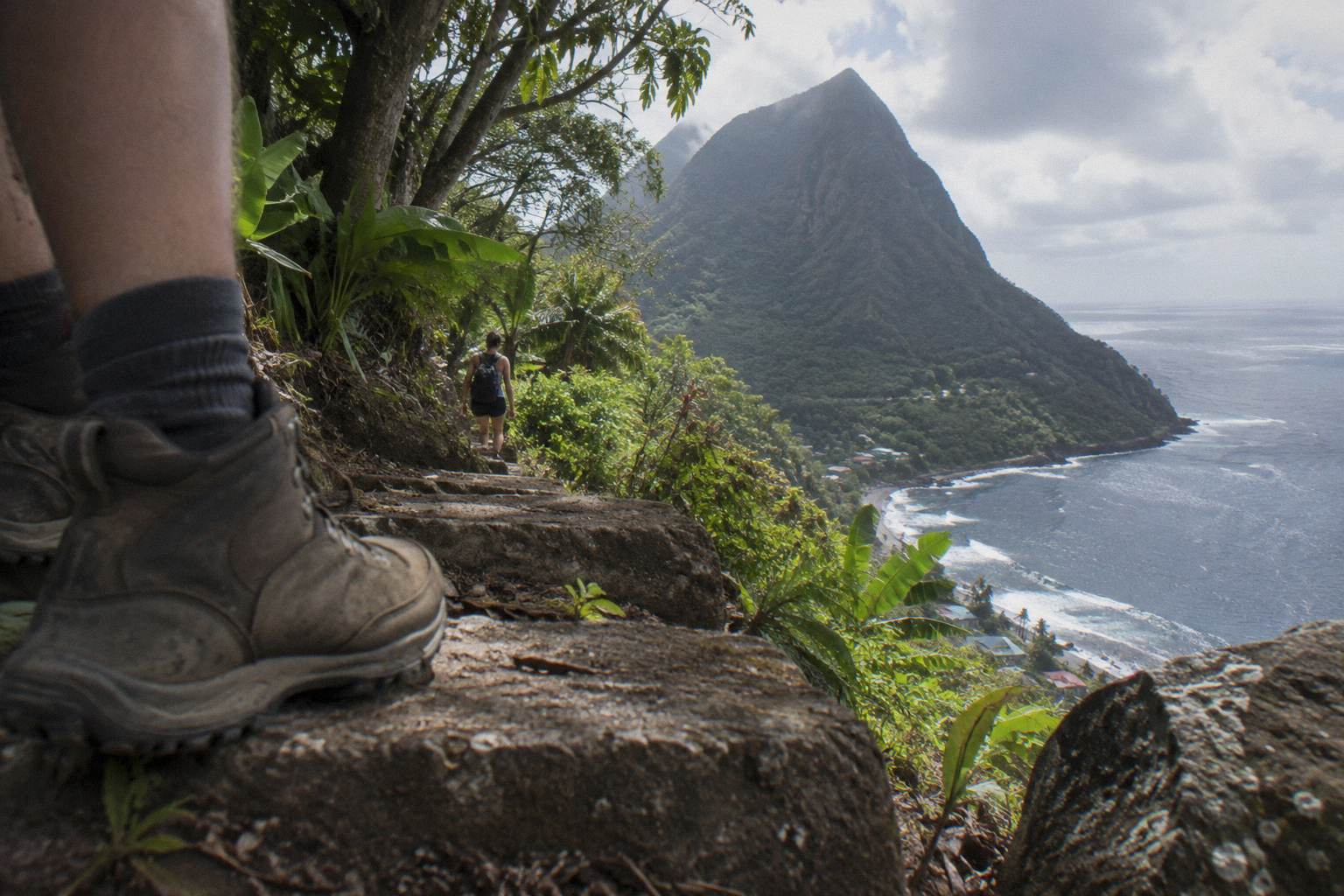
Settings logic on a tropical summit is about contrast management. The sea and sky are bright, the rock is near black, and the gap between them exceeds what any sensor holds in one frame. Expose for the highlights and accept dark rock, shoot raw if the device allows it, and avoid digital zoom, which destroys the detail that makes summit images printable. Burst mode earns its place on the summit platform, where a clearing can last seconds. Video deserves a moment too: a slow pan from Petit Piton to the north coast reads beautifully and costs nothing in battery compared to the stills you will take anyway.
| Consideration | What works on Gros Piton |
|---|---|
| Primary camera | Phone or one light zoom body |
| Carrying | Cross body strap or chest harness, never loose |
| Filter | Polariser for sea glare and sky |
| Exposure | Bias to highlights, accept dark rock |
| Mode | Panoramic at the summit, burst during clearings |
| Protection | Dry bag for batteries and any spare lens |
| Discipline | Camera away entirely on steep scramble sections |
Two non camera items do more for your photography than any setting. Footwear with grip keeps you confident enough to stop and shoot on sloping ground, and hydration keeps your hands steady at the top, which is where fatigue shows in frames. Both are covered properly on the fitness and preparation page for the Gros Piton fitness and preparation guide.
Mistakes That Ruin Gros Piton Photos
The recurring mistakes are saving everything for the summit, carrying too much gear, shooting only in portrait, and forgetting that the descent light is often the best of the day. Climbers also routinely drain batteries on the lower forest sections, arrive at the top with nothing left, and then watch a clearing they cannot photograph. The fix in every case is to treat the mountain as a continuous shoot with a summit bonus.
The summit saving error is the most common and the most costly. Parties climb through two zones of excellent light with cameras pocketed, reach a clouded top, and descend with almost nothing. The mid trail clearings and the shoulder below the boulders produce the images that actually survive editing, and they are reliable in a way the summit cap is not. The battery error compounds it: the forest section invites endless dull shots of steps and roots, each one costing power that the summit reveal needs.
| Mistake | Consequence | Better habit |
|---|---|---|
| Saving shots for the summit | Cloud cap yields nothing | Shoot the mid clearings hard |
| Heavy camera bag | Fatigue, slower climbing | One body, one zoom, phone backup |
| Only portrait framing | Sea horizon wasted | Mix wide landscape panoramas |
| Battery drain in the forest | Dead camera at the clearing | Disciplined shooting lower down |
| Ignoring the descent | Missing the day's best light | Keep the camera out going down |
| Unsecured gear | Dropped or swung equipment | Strap or harness throughout |
A subtler mistake is planning a climb purely around photographs with no buffer for the mountain's own schedule. Booking the tightest possible transport window, then needing an extra twenty minutes at a clearing, creates pressure that a longer private day absorbs easily. This is one honest argument for the private format, and one reason the Tour For The Day, 6h 45m from Tour For The Day, from US$112 per person with cruise-port pickup, and the Private Nature Trail, 7 Hours from Xceptional Tours, from US$190 per person including both the Gros Piton entrance fee and the Toraille Waterfall entry, exist at different price points for different day shapes.
Planning Your Photo Climb Around Cruise And Hotel Days
Cruise passengers face the tightest version of this planning problem, because ship time converts a 4 to 6 hour climb into a logistics calculation before any photography happens. Tours flagged with cruise-port pickup solve the transport side, and the rest is choosing a booked duration that fits the window with margin. Hotel based travellers have it easier and can pick almost any format among the tours listed here.
For cruise days, the guided options with port pickup include the Dannyboy Guided Hike, 5 Hours from St. Lucia Best Experience Tours & Airport Transfers, from US$90 per person, and the Private Hike, 4 To 5 Hours from Cool Vibes Taxi and Tours, from US$140 per person, both explicitly flagged for cruise-port pickup alongside hotel pickup. The cruise port day guide works through the full timing question. Hotel based photographers should also read the hotel pickup guide and the Gros Piton from Castries page, since northern hotels add real travel time to the day and change which booked duration makes sense.
The last planning piece is honesty about what a summit photo is worth to you. If it is the centrepiece of the trip, a private climb on a flexible day, with a spare morning in reserve, is the strongest play. If it is one highlight among many, a well reviewed guided group at a lower price does the same mountain with the same guide requirement. Either way, the trail fee mechanics on the cost and entrance fee page explain exactly what your USD 50 covers and where it is paid, and the reviews page for the climb shows what past climbers reported about their own summit days.
Whichever format you lean toward, these three climbs cover the guided, private and pickup angles of the same summit, and each booking page shows its current price and terms.
Common Questions About Gros Piton Summit Views
Can You See Petit Piton From The Top Of Gros Piton?
Yes, conditions allowing. Petit Piton at 743 m (2,438 ft) sits to the south and its full profile is one of the defining frames from the summit. Cloud can obscure it at any time, so no climb can promise the sight.
How High Is The Gros Piton Summit?
The summit stands 798 m, or 2,619 ft, above sea level. The round trip from Fond Gens Libres is 4 km and typically takes 4 to 6 hours with a certified local guide required.
Is The Summit View Worth The Climb?
Most climbers think so, but the honest answer is that it depends on the cloud cap at your summit pause. Treating the mid trail clearings and the shoulder as part of the payoff makes the day rewarding regardless of summit visibility.
What Camera Should I Bring Up Gros Piton?
A phone in a secure strap or harness, or one light camera body with a versatile zoom. The trail needs both hands at times, so anything heavy or loose becomes a burden and a risk rather than an asset.
Do You Need A Guide To Reach The Photo Spots On Gros Piton?
Yes. A certified local guide is required for the climb itself, and the USD 50 per adult trail fee covers both entry and the guide. The middle clearings and summit are all inside the guided route.
Which Tours Include Pickup For A Photography Focused Climb?
The Dannyboy Guided Hike, 5 Hours from St. Lucia Best Experience Tours & Airport Transfers offers hotel and cruise-port pickup from US$90 per person. The Private Hike, 4 To 5 Hours from Cool Vibes Taxi and Tours and the Hotel Or Cruise Pickup Hike from St Lu Taxi and Tours both cover the same pickup options.